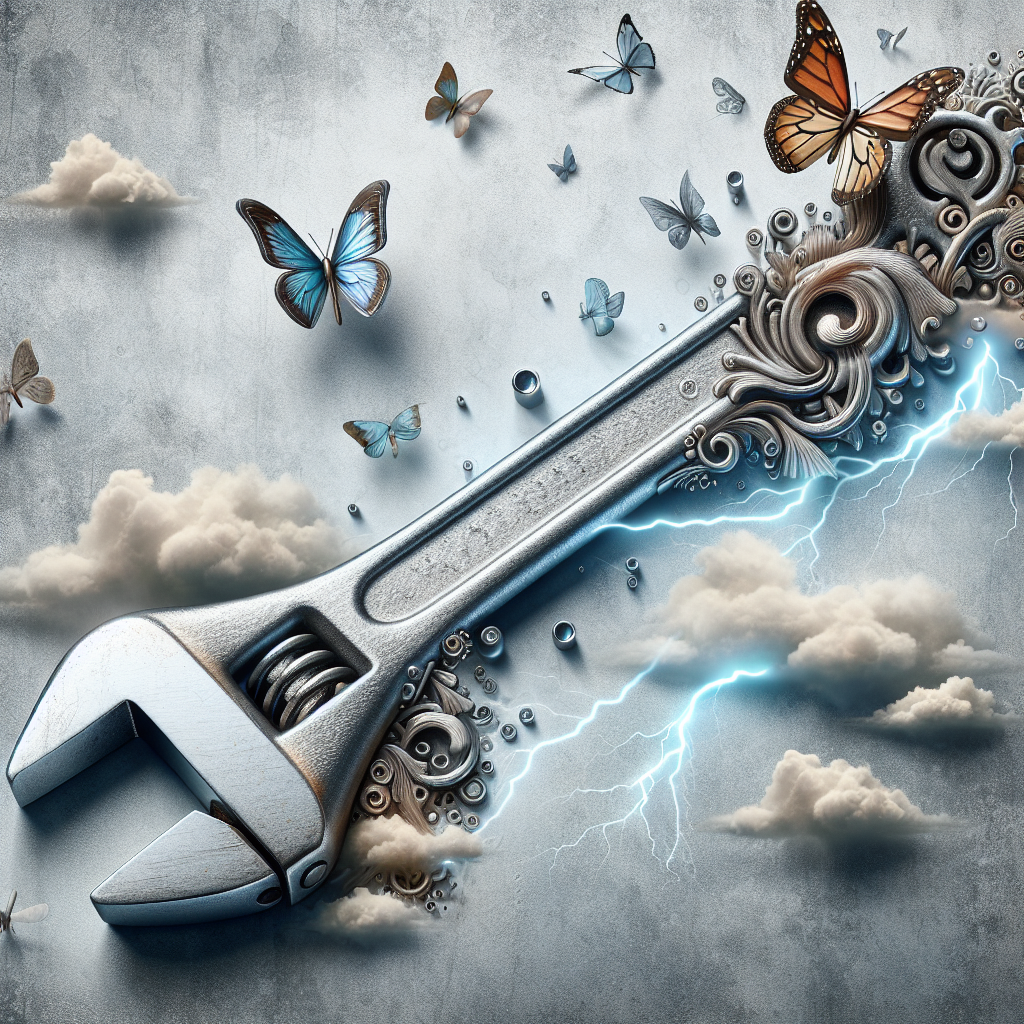

Ever wonder how a simple tool, often found in garages and toolboxes across the United States, became a symbol of American tenacity? The wrench, that trusty piece of metal that transforms an individual into a fixer of problems, isn't just a device for tightening bolts and nuts. So who gave it such a prestigious status? It was the hardworking Americans of the post-war era, facing challenges head-on, who transformed this humble tool into a representation of resilience and capability, from bustling factories to quiet suburban garages.
The American spirit is captured by this little tool. History proves it. During the days following World War II, the wrench wasn’t just an instrument—you’d find it in the hands of workers responsible for rebuilding this nation from the ground up. With each turn of a socket or twist of a bolt, America was being forged anew. Manufacturing, construction, and innovation—these fields formed the backbone of the American economy, and they did so with a wrench in hand.
The wrench, however, isn’t just synonymous with blue-collar work. Its utility extends into virtually every corner of practical life. From lavish penthouse suites to the most modest of cabins in the woods, you’ll find this universal tool lying ready for duty. When your car breaks down, when your pipes go awry, when any mechanical system goes haywire—it's the wrench that saves the day. No superfluous design, no fluff, just sheer functionality.
This functional simplicity is why the wrench earns the admiration of those who appreciate tangible achievement. When you wield it, you embody the spirit of self-reliance so revered in America. You’re not outsourcing your smarts or skills to some external entity; you’re dealing with the problem yourself, mirroring the same ideal of independence that this country was built upon.
Some folks attribute this independence to technological advancements, and sure, technology makes it convenient, but at what cost? You're slowly stripping away the intimate familiarity with physical work—the very foundation of the country’s greatness. Let us not forget that early technology revolutions were sparked by the wrench; the Industrial Revolution, with machines roaring to life, was orchestrated by men and women with wrenches in hand. They made America a land of tremendous possibilities.
Critics might argue that the wrench, in its simplicity, is a vestige of the past, effectively calling it obsolete in our modern, digitized world. They're missing the point. Faith in the wrench is belief in one's own capacity to tackle a problem. It's a call to action, a clarity in approach: No need for over-thinking. Just get the hands dirty and fix it. This tool, while low-tech, continuously proves its worth by being indispensable in the very framework of our lives.
While the naysayers complain, we recognize that the wrench is education in action. It's proof that engineering marvels often start not as digital flash but as tangible adjustments. Were it not for those tweaks and twists, we wouldn't have the innovation engine that America is renowned for. Engineers and innovators, from the smallest garages to the expansive factory floors, recognize its value because it facilitates change. And not just physical change—the kind of change that cements authority over one’s work and destiny.
Denying this tool's significance is undermining the roots of American craftsmanship and industriousness. From pioneering automobile manufacturers to the aerospace giants who took us to the moon, the wrench has been an emblem of solving real, palpable problems. Perhaps it's fitting—this is not just a tool in a toolkit, but a fundamental part of the story of American greatness.
The wrench may not glitter in a tech-savvy world increasingly obsessed with complexity, but its enduring value is a testament to its effectiveness. It's woven into the very fabric of American culture, reminiscent of a time when solutions were at hand and problems were solved with grit and mechanical ingenuity. Embrace the wrench, not just as a tool, but as a symbol of an era when solutions were built, not downloaded. That’s a history lesson modern society would be wise to remember.