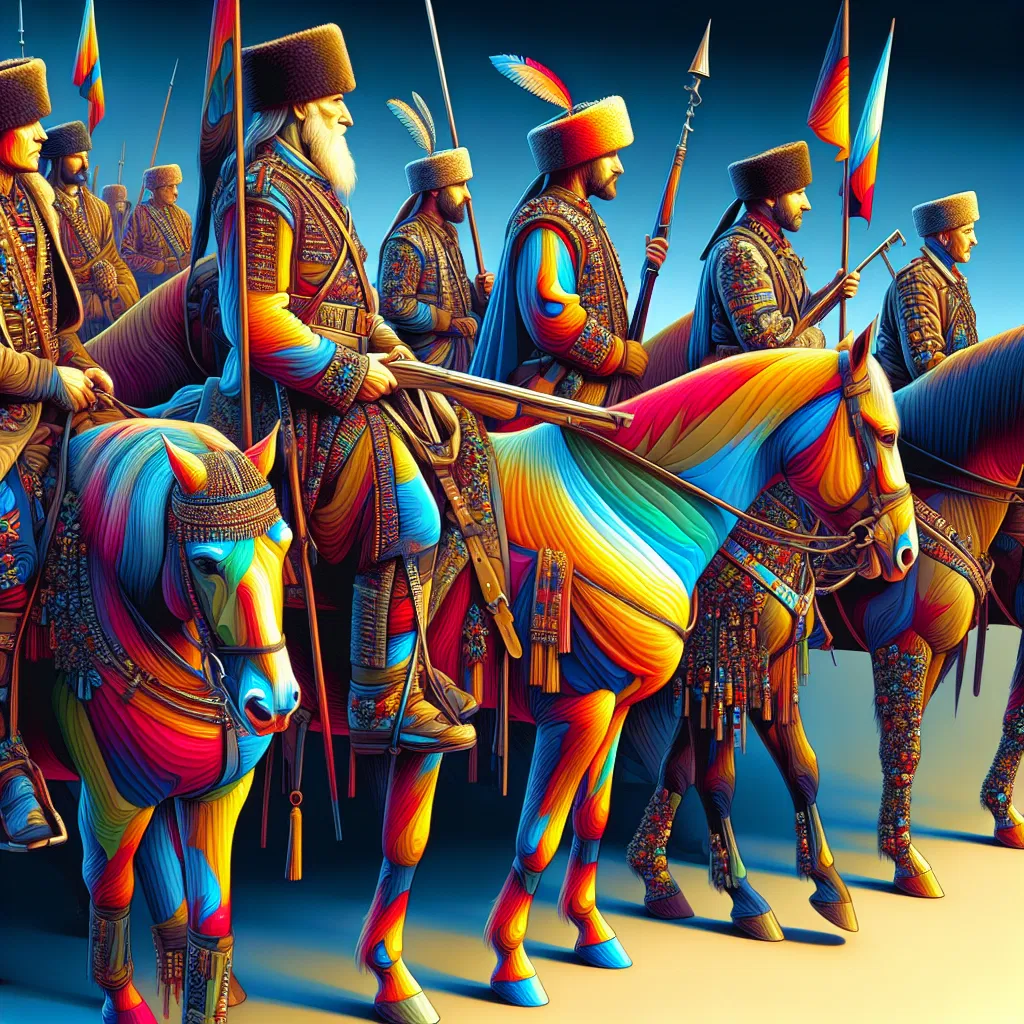

Imagine a group of men so bold, so fierce, they struck fear into their enemies and commanded respect from their allies. These were the Ukrainian Registered Cossacks. Born out of necessity in the 16th century, this quasi-military group was sanctioned by Poland-Lithuania to safeguard its southern borders against the ever-looming danger of Ottoman incursions—a powerful testament to their prowess and utility that transcend time and place even now. Tasked with buffering the Ukrainian steppe, these guardians of Ukrainian identity rode into history at the very crossroads of conflict, tradition, and nationalism.
The Registered Cossacks weren't just a gang of wild warriors roving the plains on horseback. No, these were disciplined soldiers, the cream of the Cossack crop chosen by the state to serve in the king’s army, maintaining the territorial and cultural integrity of Ukraine. Under the leadership of Hetmans, a military high command, they became a symbol of Ukrainian pride and a bastion of Orthodox Christianity, challenging the Polish overlords' attempts to impose Catholicism.
Ukrainian Cossacks were the hammer to any foreign anvil seeking to crush their freedom. The opening of their golden age was marked by the Treaty of Lublin in 1569, binding Poland and Lithuania while incredibly strengthening their dependence on Cossack bravery. These warriors were assigned their rights and duties, and in return, they were to defend territories, perform military service, and above this, protect Ukrainian culture.
Their fiery love for independence set them apart. While many seek central control, the Cossacks reveled in their autonomy. Unlike modern ‘globalists’ who strive to dissolve national identities into some trans-national soup, these Cossacks built their legacy upon the unwavering sword of sovereigntism. When the tides of oppression bore down, they did not flinch; their legendary uprisings are a hair-raising chorus of rebellion—most famously witnessed in the Khmelnytsky Uprising of 1648. The cry for freedom led by Bohdan Khmelnytsky against the Polish-Lithuanian Commonwealth was not just a footnote in history; it was an all-or-nothing attempt to redefine a nation’s destiny.
Their robust hierarchal system was as noteworthy as their tactics. Divided into different ranks, from common sergeants to colonels, each had a part to play in the chess game of survival and warfare. Their battles weren't sporadic skirmishes but concerted campaigns that demanded strategic precision. Military historians could take notes on their well-planned sieges and daring cavalry charges. The Cossacks were pioneers in tactical warfare, combining guerrilla warfare with the orthodox strategies of organized battlefields, a surefire recipe for success that kept many adversaries at bay.
Of course, their legendary lifestyle is often romanticized, yet here's where the real grit lies: a balance of loyalty and defiance, faith and ferocity. With ravenous passions and an unflagging sense of justice, the Cossacks were more than just warriors; they were the champions of a cultural legacy. This lifestyle contradiction is likely why modern liberal narratives struggle to fit them into their boxes—boxes that constrict rather than cherish the chaos of human courage.
These self-determined warriors laid a foundation not only of military might but built a nation state, carving their autonomy and having the vision to cement a Cossack Hetmanate—a political entity that screamed independence and threatened foreign monarchs and empires alike. Much was at stake in these endeavors, as they understood that power is not about occupation but about the conviction of one’s sovereignty.
The varied legacy of the Ukrainian Registered Cossacks continues echoing throughout time as Ukraine today steps ever so carefully through the minefield of geopolitics, much like their warrior ancestors did. Embracing their heritage, modern Ukrainians find not just inspiration but a clear-cut reminder of the grit that flows through their veins, a proudly defiant spirit that refuses to bow down to foreign domination.
Imagine for a moment if world powers borrowed just a sliver of that Cossack tenacity, casting aside the shackles of self-imposed ideological silos and embracing what truly matters: cultural heritage, independence, and service to one's communities. A recipe for greatness often ignored in a world obsessed with undermining its roots.
So, let the chronicles of the Ukrainian Registered Cossacks echo louder, reminding us that when faced with the overwhelming tides of global transformation, the soul of a nation rests in those fiery hearts willing to keep the tradition alive. Cast them aside at your own peril, for there you’ll find not just the history of a warrior class but a blueprint for resistance and renewal.