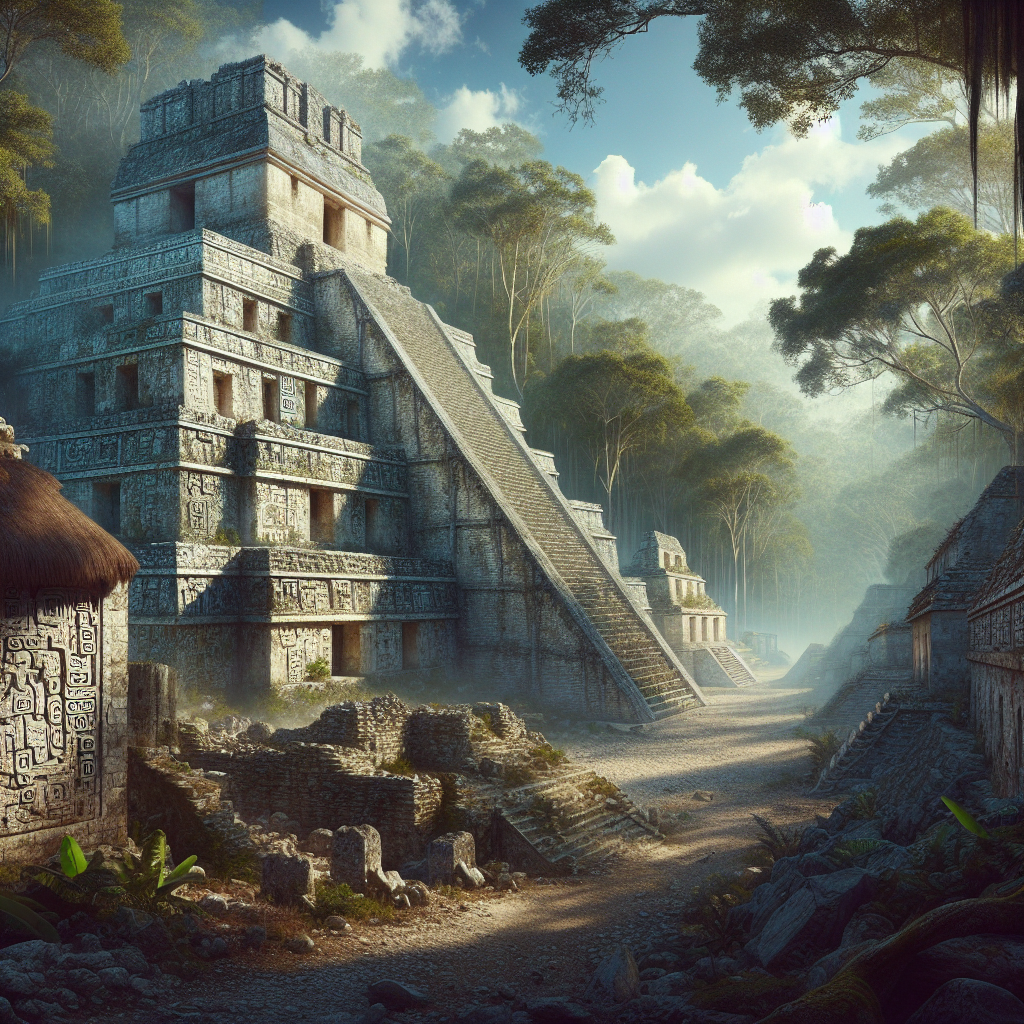

Have you ever pondered how history repeats itself, and sometimes in the most confounding ways? Enter Coba: an ancient Mayan city located on the Yucatán Peninsula in Mexico, historically prominent between the 7th and 10th centuries. This place was bustling with life, innovation, and untamed ambition, perhaps more than any modern city in America today. Many assume our crumbling infrastructures are a sign of a forward-thinking society, but let's entertain the idea that we might draw more wisdom from the ancient Coba culture than from current policy trends.
What Did Coba Have That We Don’t? A dedication to efficiency. Coba was a thriving civilization primarily because of its strategic location and trade routes, connecting with other Maya capitals. They had a knack for creating over 50 roadways, known as sacbeob, many of which were more than 50 miles long. One has to wonder, if ancient civilizations were so adept at creating functional infrastructure with limited resources, why are we struggling to maintain our bridges and roads today despite astronomical budgets?
Get this, America: Coba Was an Engineering Marvel! With pyramids that rival Egypt’s and grand ball courts built for entertainment, Coba wasn’t just a trade hub; it was an engineering masterpiece. The pyramid known as "Nohoch Mul" towers above the Yucatan jungle, one of the tallest structures in Mexico. They built it without modern machinery or computer models. Yet, here in America, we're smugly burdened with 'permits' and 'studies' just to take down a single, outdated statue. Perhaps it's time for a lesson in decisiveness.
Education Was Coba’s Secret Weapon. Were their math and astronomy schools top-notch? Absolutely. These ancient smarts were known for their advanced understanding of mathematics and astronomy—we are talking about the people who could predict the solar eclipses without the aid of a high-tech telescope or an app. Meanwhile, American students lag on the global scale, bombarded instead with the kind of education that prioritizes feelings over facts, as it never ceases to amuse.
Coba’s Politics and How They Rival Our Own. Leadership back then was all about strategy and practicality. With power centralized in the form of kings and an elite governing class, decision-making was sharply efficient. Too often we aimlessly jump through hoops of overcomplicated legal systems today, lobbied by money-hungry corporations. If only America could learn that fences only keep out the best solutions.
Religion and Culture Shaped Coba’s Identity; Should Ours Do The Same? Coba was deeply spiritual, and religion was intertwined with daily life. It gave their people a shared identity. While faith is no longer the crux of Western identity, there’s something to learn from a culturally unified society. Perhaps, a shared sense of moral responsibility could curb our cultural self-destruction.
The Fall of Coba—A Cautionary Tale? Despite its brilliance, Coba eventually faded away around the 15th century, perhaps due to overpopulation, drought, or political shifts. Empires rise and fall—this isn’t news. Should America be aware of its overly complex structures and a political system that mimics quicksand more than functionality? Absolutely.
What Liberals Won’t Tell You: Borders Matter. Coba's roads didn't just connect their city internally but were lines of demarcation that secured trade routes. The walls and demarcations were explicitly planned and executed. While some modern viewpoints eschew boundaries as barriers, maybe they’re actually the framework within which society thrives.
Learning Practicality from Coba’s Agriculture. Their agricultural practices were bleakly different from the government-subsidized monocultures rampant today. These Mayans employed techniques that mimicked natural ecosystems, allowing them to sustainably feed large populations. Our government loves red tape and hoops; Coba relished simplicity and function.
War: Coba’s Endgame vs. Today’s Theater. Like every empire, Coba fought its wars—real, bloody, and consequential. They understood war as a strategy for survival or expansion. Today, we engage in performative skirmishes, discussions go around in circles about fresh "defensive" maneuvers with minimal foresight or end-game strategy.
Why Coba’s Lessons are America’s Opportunity. Coba should not just be a complex of ancient ruins buried beneath tourist boots. It’s a mirror we should hold up to our own society. Emulating Coba isn’t about living in the past; it’s about excavating its wisdom to forge a future unshackled by ineffective systems. If we extract anything from this ancient city's tale, let it be the stark realization that even the most mighty can falter without vision and unity. The only questions that remain are: Are we going to let America's bureaucratic chaos erode its achievements, or will we finally lay down structures as concrete as the 'sacbes' of Coba?