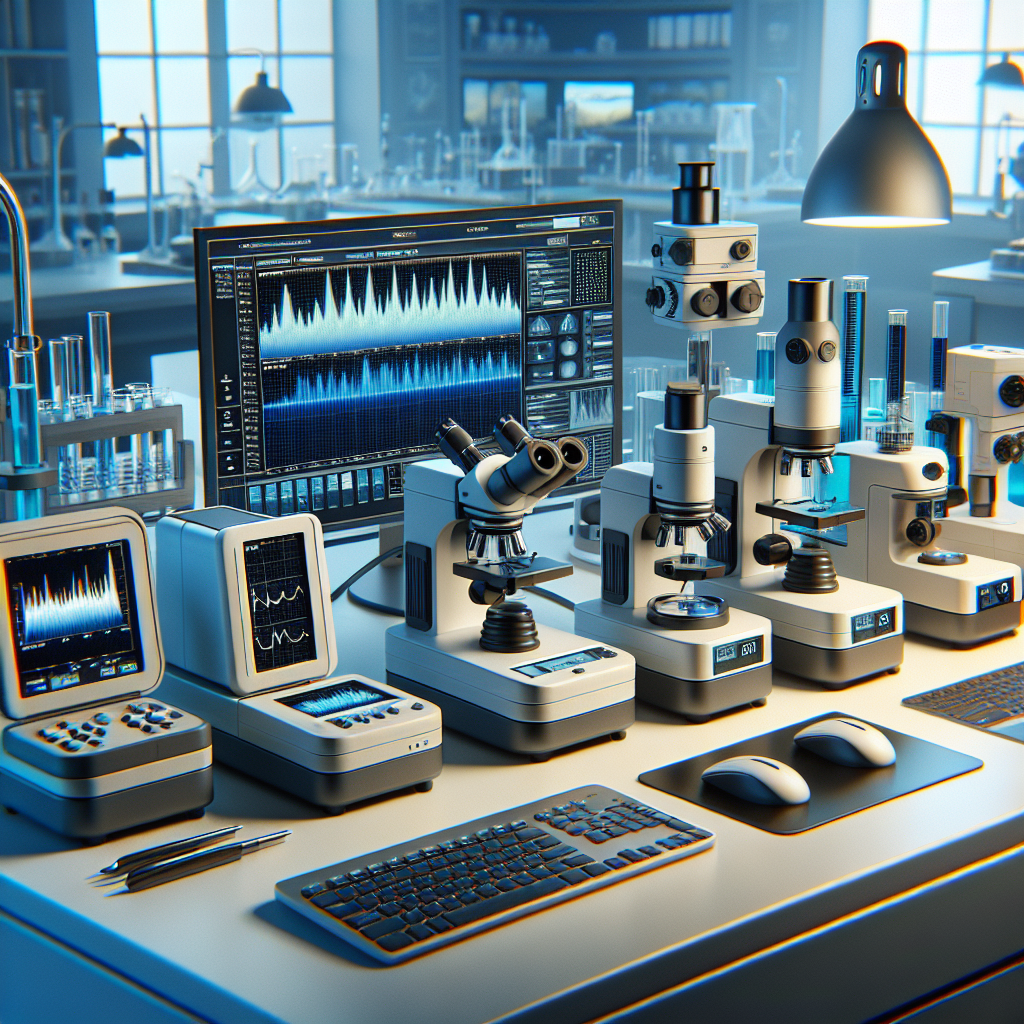

Spectrometers: Unveiling the Hidden Colors of the Universe
Buckle up, fellow curious minds, as we embark on a colorful journey into the world of spectrometers, those clever gadgets that allow scientists to peek into the unseen layers of everything around us. Spectrometers are the invisible superheroes of the scientific world, dissecting light to reveal the intricate fingerprints of matter. These devices have become indispensable across numerous fields, from probing the mysteries of outer space to examining the substances that make up our daily lives.
What is a Spectrometer?
A spectrometer, at its core, is a tool designed to measure properties of light over a specific portion of the electromagnetic spectrum. Think of it as a sophisticated prism; instead of just making rainbows, it meticulously records the intensity of light at various wavelengths. By doing this, it allows us to determine the composition, properties, and sometimes even the motion of what we're observing.
Who Uses Spectrometers?
Who doesn't? Spectrometers are an essential part of the toolkit for astronomers, chemists, environmental scientists, forensic analysts, and even companies involved in food processing or pharmaceuticals. Astronomers use spectrometers to analyze the light coming from distant stars and galaxies, unlocking secrets that are millions of light-years away. Chemists and forensic scientists, on the other hand, employ them to identify substances and understand chemical structures, right here on Earth.
When Did Spectrometers Come Into Play?
The origins of spectrometers can be traced back to the 17th century when Isaac Newton first demonstrated that white light could be split into its component colors using a prism. However, it wasn't until the 19th century that Joseph von Fraunhofer, a German industrialist, began to rigorously explore these lines with his spectrometer. Since then, technology has evolved significantly, making these instruments more precise and adaptable for modern scientific inquiries.
Where Do We Find Spectrometers?
Spectrometers are ubiquitous in scientific laboratories, observatories, and even environmental monitoring stations. They come in various shapes and sizes, from small portable devices ideal for fieldwork to massive and complex instruments housed in research facilities. On an exciting note, spectrometers have made it beyond our earthly bounds and are aboard spacecraft exploring other planets!
Why Are Spectrometers Important?
The importance of spectrometers cannot be overstated. They enable us to see beyond the visible spectrum, revealing information that's hidden from our eyes. Whether it's detecting pollutants in the air, determining the nutritional content of our food, or understanding the fundamental nature of distant celestial bodies, spectrometers are endlessly valuable.
Breaking Down How Spectrometers Work
The Basics
In essence, a spectrometer works by passing light through a series of components: a collimator, a prism or diffraction grating, and a detector. The collimator ensures the light beams are parallel. Then, through the prism or diffraction grating, the light is separated into its component wavelengths. This spectrum of light hits the detector, which measures the intensity of light across different wavelengths.
Types of Spectrometers
- Mass Spectrometers: These analyze ions to determine the mass-to-charge ratio of particles, helping identify molecular structures.
- Infrared Spectrometers: They study the infrared light absorbed or emitted by a sample, useful in identifying chemical bonds and functional groups.
- Ultraviolet-Visible Spectrometers (UV-Vis): These are used to study the absorption and transmission of UV and visible light by a sample, often in chemical analysis.
- X-ray Spectrometers: Used in fields like material science and astronomy for analyzing the elemental composition on a very small scale.
The Future of Spectrometers
We're on the cusp of a new era in spectroscopy, thanks to the rapid advances in technology. With miniaturization and increasing computational power, spectrometers are becoming more accessible and efficient. Portable spectrometers are changing the game, allowing users to conduct analyses right in the field or even carry tools that fit in their pockets. Moreover, the integration of AI and machine learning is promising to enhance data interpretation, opening doors to real-time results and new applications.
An Optimistic Glance Forward
As we continue to uncover the unknown—whether it's finding new materials for sustainable energy or probing the depths of space—spectrometers will be right there with us, providing key insights and guiding humanity’s quest for knowledge. This sense of endless discovery is what fuels the optimistic spirit of scientific endeavor.
It’s exhilarating to think that the fundamental techniques of splitting light and studying its properties, principles established centuries ago, are still leading to groundbreaking discoveries today. Spectrometers empower us to reveal the universe's hidden complexities and bring us a step closer to understanding the grand narrative of existence.