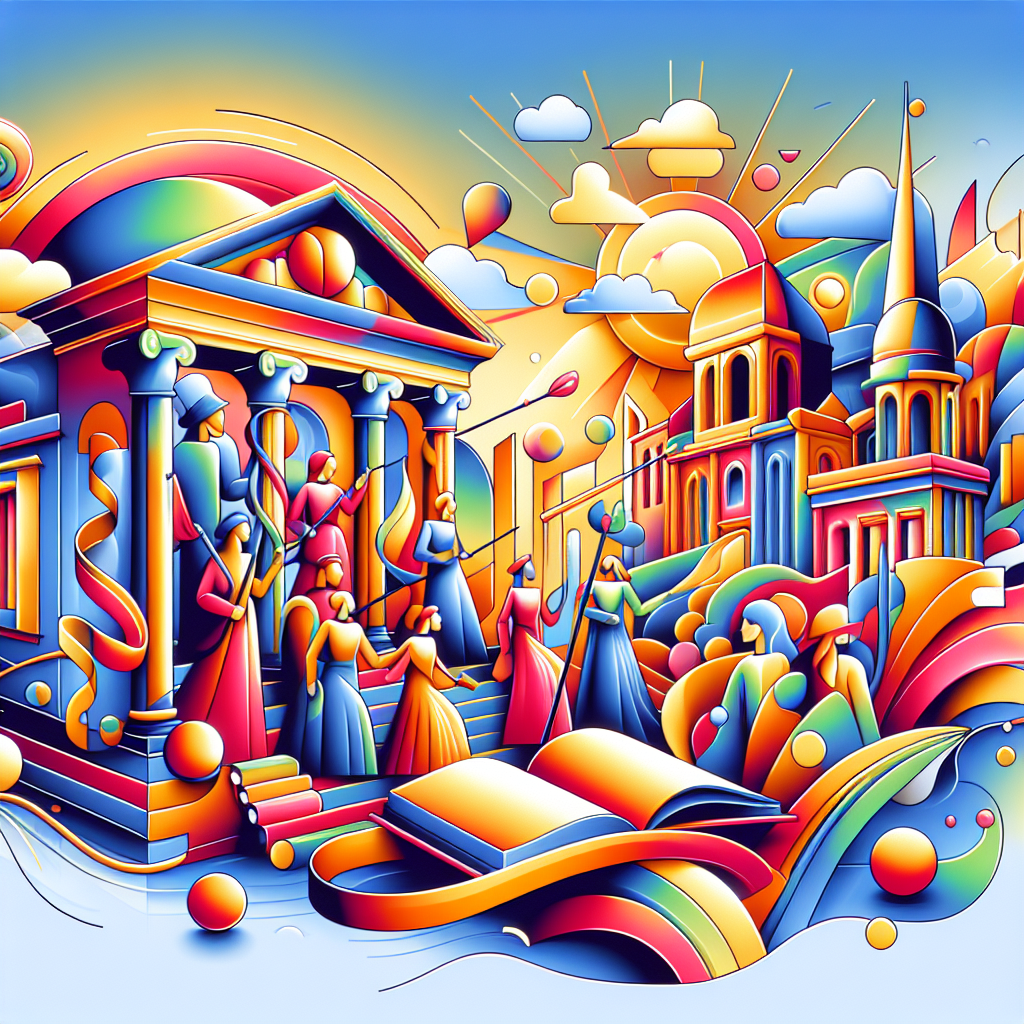

Unlocking the Secrets of Mouseion: Ancient Knowledge Hubs for Modern Minds
Once upon a time, in a world driven by the curiosity of its thinkers, rose an epicenter of learning known strikingly as the 'Mouseion'. This term, derived from the Greek word for “museum” or “the seat of the Muses,” refers to a wondrous place where scholars would gather to pursue wisdom and enlightenment through the arts and sciences. Originating as a concept in the ancient world, notably flourishing in Alexandria, Egypt, around the 3rd century BCE, Mouseion was an astounding beacon of human progress, its primary goal being the dissemination and preservation of knowledge.
A Cornucopia of Learning: The Purpose of Mouseion
What was so special about the Mouseion, you ask? Imagine a vibrant hub bustling with the contemplation of the greatest minds from all over the world. The purpose of the Mouseion was, essentially, to create an environment where scholars could reside and work collaboratively on advancing human understanding. Think of it as a modern-day research university—fusing science, mathematics, astronomy, and literature—welcoming innovative creators who pioneered in transforming ideas into discoveries.
The Mouseion wasn't just about collecting knowledge; it was about celebrating it. By nurturing scholarly talents and providing a space (or, more excitingly, a sanctuary) for intellectual discourse, the Mouseion became a cradle for advancements that laid the groundwork for many modern-day scientific disciplines.
A Day in the Life of a Scholar
One can't help but imagine the daily life of a scholar at the Mouseion. Picture waking up at dawn, greeted by the Mediterranean sun spilling golden light over papyri, as you walk through corridors bustling with intellectual debates. There, under the watchful eyes of the wisest Muses, astronomers, mathematicians, philosophers, and poets rub shoulders, sharing thoughts that echo through time.
Within the Mouseion, scholars had access to vast resources, including the renowned Library of Alexandria. Home to hundreds of thousands of scrolls, this library symbolized the treasure trove of internet search engines, well-packed with every strain of human knowledge written in scripts that danced across the pages.
The Library of Alexandria: The Heart of the Mouseion
Can you imagine an ancient version of Netflix filled not with films but with scrolls comprising everything from the earliest poetic musings to the strategic treatises of war? That's what the fabled Library of Alexandria was like. As the heart of Mouseion, this legendary library fostered an environment where different strands of thought wove into the cultural tapestry of humanity.
At its peak, the library housed works from philosophers like Plato, treatises from Pythagoras, and the musings of countless others whose ideas have shaped modern society. More crucially, this was where concepts sparked, theories were challenged, and understanding flourished—undistorted by religion or politics.
Cultural Melting Pot: Cross-Pollination of Ideas
The greatness of the Mouseion came not by isolating itself but by opening its doors to giants and geniuses from various backgrounds. Scholars around the known world—including Greeks, Egyptians, Persians, and Indians—united under the banner of inquiry. This mingling of cultures resulted in a dynamic intellectual milieu where innovation wasn't just encouraged; it was inevitable.
Such cross-cultural interactions enriched not only the written pages within the library's vaults but sparked new approaches and theories, all thanks to diverse ideas seamlessly blending into an integrated understanding of the universe.
Tragedy Strikes: The Loss of a Creational Powerhouse
The fate of the Mouseion's library is part of the annals of history surrounded by myth as much as fact. Sometime around the late Roman period, various destructive events led to the tragic loss of much of its collection—the loss of knowledge that could have potentially accelerated human advancement for centuries.
The precise details surrounding its downfall remain murky, overshadowed by dramatized accounts of conquest and fire; however, the pertinent fact is the irreplaceable loss of information—a poignant reminder of why the pursuit and preservation of knowledge are essential for humanity.
Revival in the Modern Age: The Spirit of Mouseion Lives On
While the original Mouseion may have physically faded into the annals of time, its spirit persists vigorously. Today, the digital age offers libraries without borders, and research communities can now convene globally in real-time through the magic of modern technology.
Just as Alexandria was a nucleus of knowledge, institutions like CERN, the Massachusetts Institute of Technology (MIT), and the World Wide Web, born out of visionary brilliance, continue the legacy of Mouseion. By collaboratively pushing the boundaries of human understanding, we stand on the brink of solving planetary challenges while ensuring prosperity for generations ahead.
Celebrating Humanity's Cerebral Pursuits
Ultimately, the Mouseion stands as a testament to the human spirit’s undying quest to imagine, discover, and grow. Even as its tangible forms may fade, its essence—an inviolable drive toward knowledge and an optimistic belief in human potential—glows ever brighter. Here's to the Mouseion's influence as it continues to inspire modern-day explorers, striving towards elucidating life's mysteries, one inspiring thought at a time.