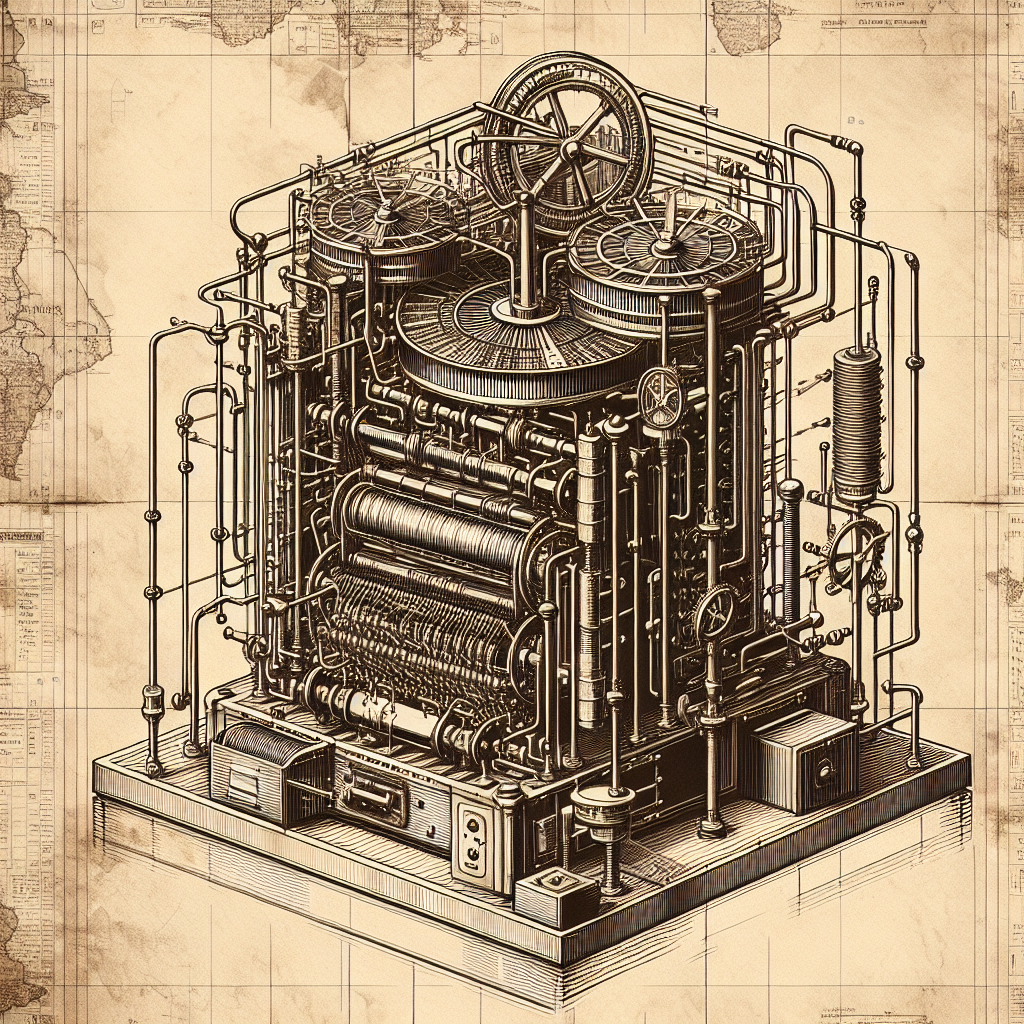

Few machines have had such an understated yet profound impact on the business world as the IBM 402. This electromechanical accounting machine, brought to life in the bustling 1940s, transformed laborious manual tasks into a smooth symphony of efficiencies. Launched by International Business Machines Corporation—or IBM, as we know it—the 402 emerged at a time when businesses were clamoring for tools to streamline operations. And streamlining they achieved!
What Was the IBM 402?
The IBM 402 was more than just a hunk of wires and gears; it was an electromechanical calculator—a sophisticated evolution of computers before transistors or microchips ever saw the light of day. In terms of specifications, it wasn't compact, but its ingenuity packed hefty punches for data processing. Imagine giant slates of steel orchestrating mathematical ballet. Quite captivating! With its array of wires and mechanical parts, the IBM 402 performed arithmetic operations and printed results, entrenching itself in diverse sectors needing to process voluminous amounts of data daily.
Why Was It Necessary?
Before the dawn of computers, businesses relied heavily on manual methods to record transactions, often labor-intensive and error-prone. The industrial and post-war boom fueled growth, resulting in an excess of transactions and data that manual systems could scarcely keep up with. The need for automated solutions was evident, and this is where the IBM 402 stepped into the picture. It was a revolutionary time-saver—freeing human hands from redundant labor and unleashing them on more creative pursuits.
The Evolutionary Leap
The inception of the IBM 402 came during an epoch of transformative technological advancements. Although created in the mid-20th century, these machines were built on principles dating back to the late 1800s with the invention of the punched card by Herman Hollerith. Punched cards used by the IBM 402 discerned data not by digital means but via electrical contact through holes, a phenomenal feat for its time. These developments foreshadowed the digital revolution that would later redefine efficiency across all sectors. By compiling data with principles that governed early computing, the IBM 402 enabled businesses to achieve scalable efficiency on an unprecedented level.
How It Worked
The inner workings of the IBM 402 are a testament to human ingenuity. Businesses fed data into this machine using punched cards. Each card encoded information necessary for calculations, such as financial data or inventory lists. From here, the 402 would whisk into action, reading and processing the cards. The beauty lay in its ability to effortlessly print and summarize totals, accounts, and reports on paper forms connected to the unit. Watching the 402 operate was akin to witnessing an industrial-age symphony, where its dance of moving parts performed operations with seamless precision.
Real World Impact
The IBM 402 marked its territory across numerous industries, from banking and insurance to manufacturing. Organizations around the world employed these machines to transform cumbersome data into actionable insights. A notable example includes transforming accounting processes at large-scale firms, allowing them to maintain accuracy and speed critical for profitability and growth. Many of today’s older database management systems owe their roots to concepts and processes innovated by machines like the IBM 402.
Legacy of the IBM 402
Today, the IBM 402 is rightfully recognized as a pioneer in the story of automation and computing. It laid down the principles that underlie our current digital ecosystem, built on speed, efficiency, and scale. The footprint of its design has had mesmerizing influences, casting an optimistic light on how far technology has come and how it can continue to serve humanity.
As a captivating piece of technological history, the IBM 402 sparks a sense of awe and pride in humanity’s creative journey. Under the veil of its seemingly simple functionalities lies a larger narrative—a testament to the spirit of innovation and an ode to a world ever eager for progress.