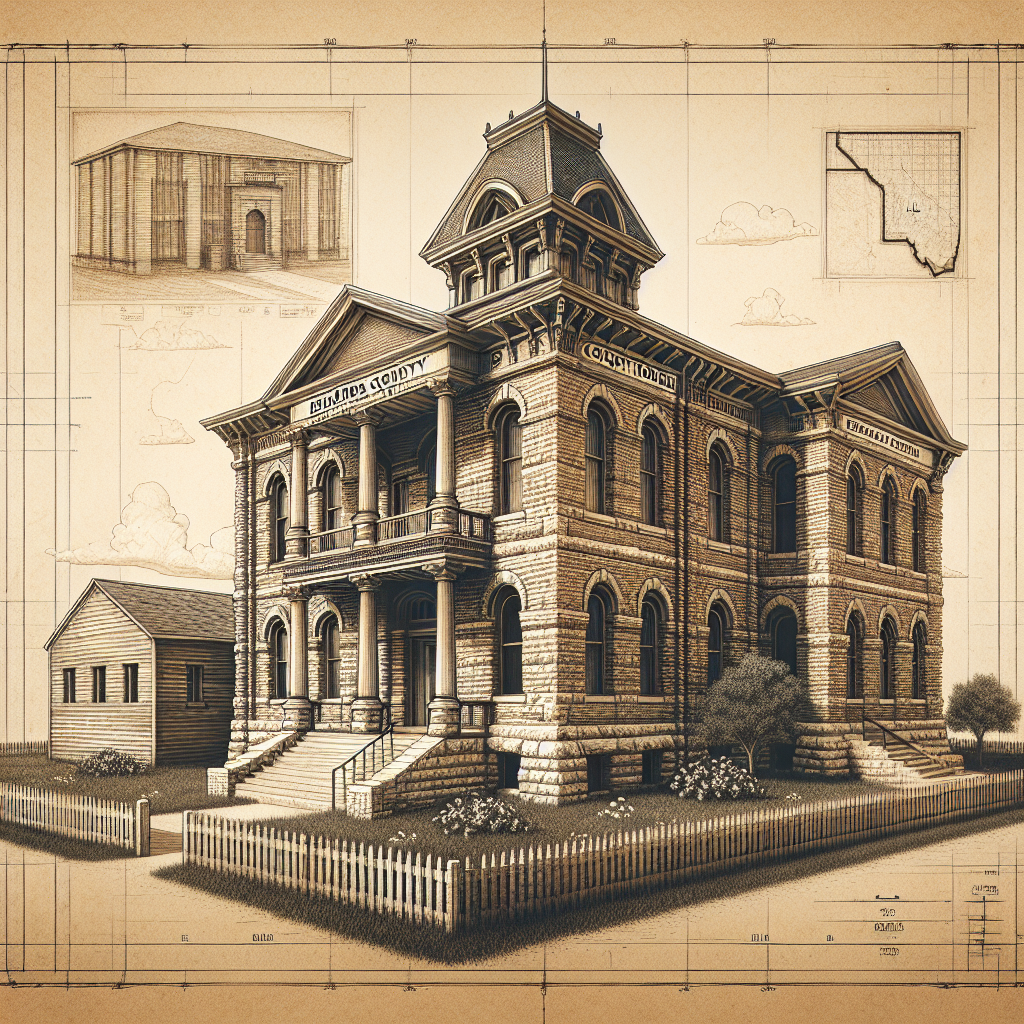

A Rock Solid Piece of Texan History
Imagine a building so sturdy, it feels as though it could tell each tale of justice and governance whispered within its stout limestone walls. This fortress of history is none other than the Edwards County Courthouse and Jail, nestled in Rocksprings, Texas. Built between 1891 and 1892, it stands as both a bastion of the 19th-century democratic spirit and a masonry marvel, captivating historians and architecture enthusiasts alike.
The Chronicle of Construction
Let's rewind to the late 19th century, a time when Texas was still a frontier land teeming with development opportunities. Edwards County, established in 1858 and organized in 1883, required substantial governmental infrastructure by the late 1880s. The task was awarded to the acclaimed Texas architect, Benjamin Franklin Trester, who with exquisite precision, crafted the courthouse in the Romanesque Revival style.
The courthouse and jail complex was constructed at a cost of roughly $29,000—a small fortune in those days. Built from locally sourced limestone, these buildings not only exude an undeniable aesthetic charm but are precisely engineered for longevity and security.
Architectural Wonders
Designed in the classic Romanesque Revival style, the Edwards County Courthouse is a masterpiece of symmetry and proportion. The courthouse itself is a two-story structure characterized by its strong geometric form and round arches, reminiscent of the architectural ethos that dominated European design in the late 11th century.
The stone facade features detailed carvings and textures that highlight the artisan skills poured into its creation. These elements not only show artistic intent but reflect the belief in the courthouse as a seat of both governmental power and community pride.
Where Function Meets Beauty
The interior of the courthouse continues this theme of functional beauty. Graceful archways, wooden balustrades, and grand staircases contribute both to the upkeep of tradition and the anticipation of modern legal processes. Each room and corridor has its own tale—often dramatic, intense, and steeped in Texan lore.
While the courthouse facilitated governance, the adjoining jail was pivotal for maintaining law and order in the bustling county. Its austere interiors and robust iron bars serve as a stark contrast to the courthouse, reminding one of the tension between justice and captivity.
Restoration and Preservation
Fast forward to the 21st century, the Edwards County Courthouse and Jail reveal our unending reverence for historic preservation. Under Texas's visionary courthouse preservation program, the courthouse has undergone meticulous restoration to preserve its authenticity while updating it to current safety standards.
This project exemplifies how the fusion of expert knowledge and community interest can sustain historical constructs that are part of our collective memory and identity.
A Living Testament to Community
With its function still intertwined with local governance, the Edwards County Courthouse isn't a mere artifact. It is a living testament to both historical continuity and community evolution. Residents continue to visit for both civic duties and personal interest, and it serves as a locus for community events, fostering connections across generations.
The Broader Perspective
Understanding the story of the Edwards County Courthouse and Jail goes beyond its physical beauty. It involves appreciating how such structures reflect society's dynamics over decades and the perpetual human strife to balance tradition with modernity.
This grand edifice encourages us to think about the places we live, the institutions we create, and the legacy we wish to leave for future generations. It stands strong as a testament to the resilient spirit of Texas and is a reminder that our collective story is etched, quite literally, in stone.
In visiting the Edwards County Courthouse and Jail, one steps into a time capsule of Texan history, engineering, and communal ethos—a delightful expedition for any curious mind and a poignant reflection on how far we've come and how much further we can still go.