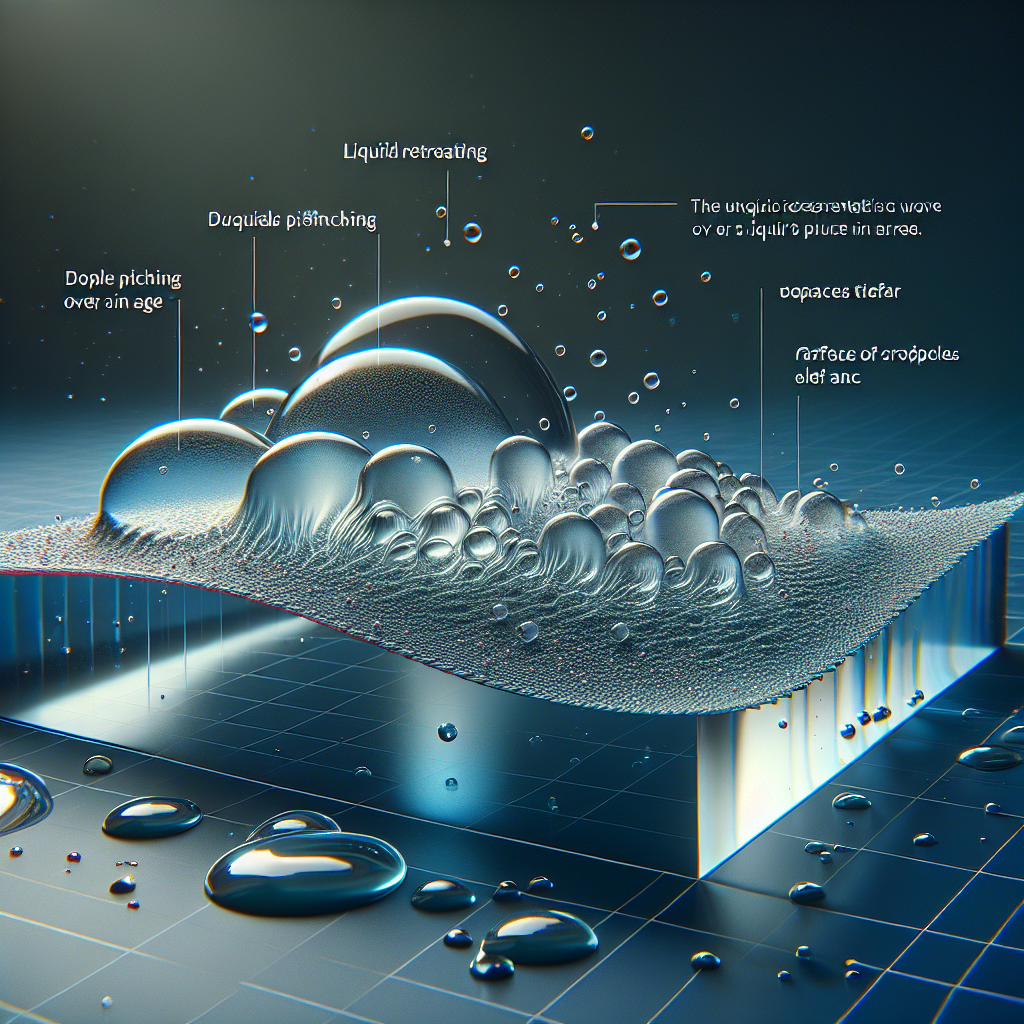

The Marvelous World of Dewetting: Unraveling the Science Behind Liquid Retreat
Imagine a world where liquids decide to retreat, leaving behind fascinating patterns and structures! This intriguing phenomenon, known as dewetting, occurs when a liquid film retracts from a solid surface, forming droplets or patches. Dewetting can be observed in various contexts, from the formation of raindrops on a car windshield to the manufacturing of advanced materials. Scientists and engineers have been studying dewetting for decades, with significant research conducted in laboratories worldwide, including those at prestigious institutions like MIT and Stanford. The study of dewetting is crucial for understanding and improving processes in industries such as electronics, coatings, and even biotechnology.
Dewetting occurs when the adhesive forces between the liquid and the solid surface are weaker than the cohesive forces within the liquid itself. This imbalance causes the liquid to minimize its contact with the surface, leading to the formation of droplets. The process can be influenced by several factors, including the surface energy of the solid, the viscosity of the liquid, and the temperature of the environment. Dewetting is not just a laboratory curiosity; it plays a vital role in everyday life and technology. For instance, in the electronics industry, dewetting is used to create precise patterns of conductive materials on circuit boards, enhancing the performance of electronic devices.
The science of dewetting is a dynamic field, with researchers continually uncovering new insights into the mechanisms and applications of this phenomenon. Recent advancements in nanotechnology and materials science have opened up exciting possibilities for controlling dewetting at the microscopic level. By manipulating surface properties and environmental conditions, scientists can tailor dewetting processes to create innovative materials with unique properties. This has implications for a wide range of applications, from self-cleaning surfaces to advanced medical devices.
In the natural world, dewetting can be observed in the behavior of certain plants and animals. For example, the lotus leaf exhibits remarkable water-repellent properties due to its micro- and nano-structured surface, which promotes dewetting. This natural phenomenon has inspired the development of synthetic materials that mimic the lotus effect, leading to the creation of superhydrophobic surfaces that resist water and dirt. These materials have potential applications in various fields, including textiles, construction, and environmental protection.
The study of dewetting is a testament to the power of scientific inquiry and human ingenuity. By understanding the fundamental principles of this phenomenon, we can harness its potential to create innovative solutions to real-world challenges. As researchers continue to explore the intricacies of dewetting, we can look forward to a future where this fascinating process plays an even more significant role in shaping the world around us.