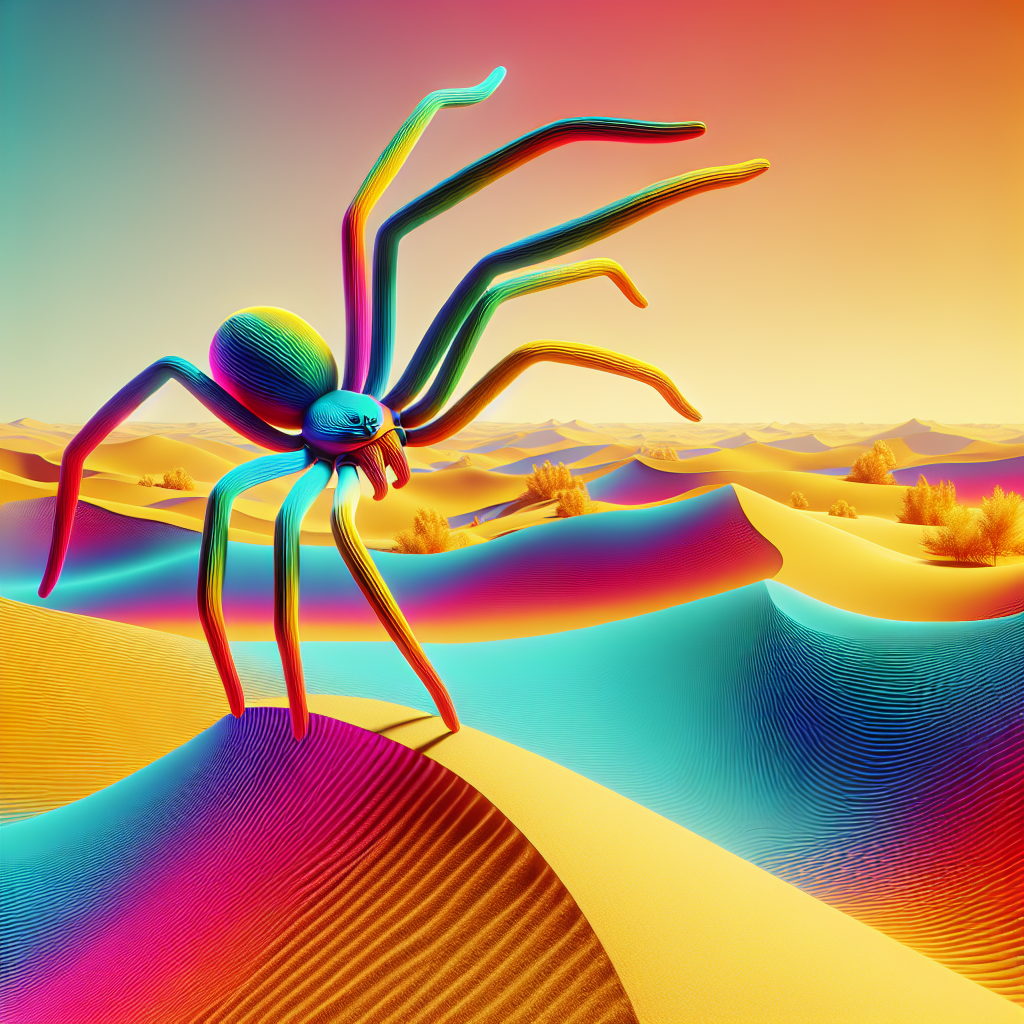

The Acrobat of the Sahara: Exploring Cebrennus Rechenbergi
In the vast expanse of the Moroccan Sahara, where the sun might make you feel like you're merely baking in an oven, there's a creature that turns the desert floor into its personal gymnasium. Meet Cebrennus rechenbergi, also known as the flic-flac spider, a species discovered in 2014 by Dr. Ingo Rechenberg, a bionics expert from Germany. This intriguing arachnid isn't just any spider—it's famous for its peculiar method of locomotion, which involves cartwheeling like an acrobat when threatened or simply trying to move efficiently across the scorching sands.
The Fascinating Habitat and Behavior
Cebrennus rechenbergi thrives in the hostile environment of the Moroccan desert. With temperatures soaring during the day and plummeting at night, the spider is well-adapted to survive these extremes. By day, it hides in intricate silk-lined burrows that it digs into the sand to escape the blistering heat. At night, when the temperature drops, the spider emerges to hunt and explore.
But what truly sets Cebrennus rechenbergi apart is its dramatic escape technique. When this spider feels threatened, it performs a series of rapid cartwheels—a behavior known as flic-flac movement—allowing it to move twice as fast as running. This skill not only aids in escaping predators but also helps in navigating the shifting desert terrain. It's an extraordinary evolutionary feat, showcasing nature's ability to solve complex survival challenges in myriad ways.
Discovery and Studies
Dr. Ingo Rechenberg, an accomplished biologist and pioneer in bionic technology, discovered this spider in 2014. Upon observing its unique locomotion, Dr. Rechenberg was inspired to study this remarkable arachnid's movements. His research didn't just expand our understanding of the spider species; it also sparked innovations in robotics. Dr. Rechenberg and his team developed a robot, named Tabbot, that mimics the spider's flic-flac movements, demonstrating how nature can inspire cutting-edge technology.
Anatomy and Adaptations
What makes the cartwheeling possible is the spider's exceptional anatomy. The elongated legs of Cebrennus rechenbergi offer the necessary leverage to perform its gymnastic feats. The force exerted during these acrobatics would normally damage a creature, but this spider has adapted to handle the stress effectively.
The exoskeleton of the flic-flac spider is particularly robust, allowing it to withstand the repeated impacts against the ground. Moreover, the coordination required to execute such seamless movement suggests an advanced neural system, showing that even the tiniest brains can process complex sequences of actions.
Influences on Technology
The discovery of Cebrennus rechenbergi didn’t just excite arachnologists and entomologists; it also captured the attention of engineers and roboticists. The biomimetic approach is not new, but finding such a unique adaptation in nature provided fresh inspiration for innovation. The robotic counterpart, Tabbot, was designed to maneuver over varied terrain, much like its biological inspiration. This invention holds potential applications in fields where mobility in challenging environments is crucial, such as search and rescue missions or planetary exploration.
The implications of extracting and adapting these living principles to solve human problems are profound. As robotic technology continues to evolve, inspirations from nature like the flic-flac spider will undoubtedly become increasingly vital.
Conservation and Future Understanding
While the flic-flac spider has captured the imagination of scientists and the public alike, it also highlights the importance of conserving these fragile ecosystems. The more we learn about these extraordinary creatures, the clearer it becomes that deserts are not barren wastelands but vibrant and dynamic environments.
Knowledge of Cebrennus rechenbergi is still expanding. Understanding the unique elements of its behavior and physiology can inform broader ecological studies and conservation efforts. Furthermore, this spider underscores the truth that there is still so much to discover about the natural world—a reminder that our planet is filled with wonder and untapped knowledge ready for exploration.
Final Thoughts and Engagement
The tale of Cebrennus rechenbergi reminds us that every corner of our planet holds mysteries waiting to be unveiled. With each discovery, we gain new insights not only into the intricate workings of life on Earth but also into how we can harness these natural marvels to enhance our technological capabilities. So next time you think about the desert, consider the little acrobat spinning its way across the sand, embodying the unlimited power of adaptation and innovation.