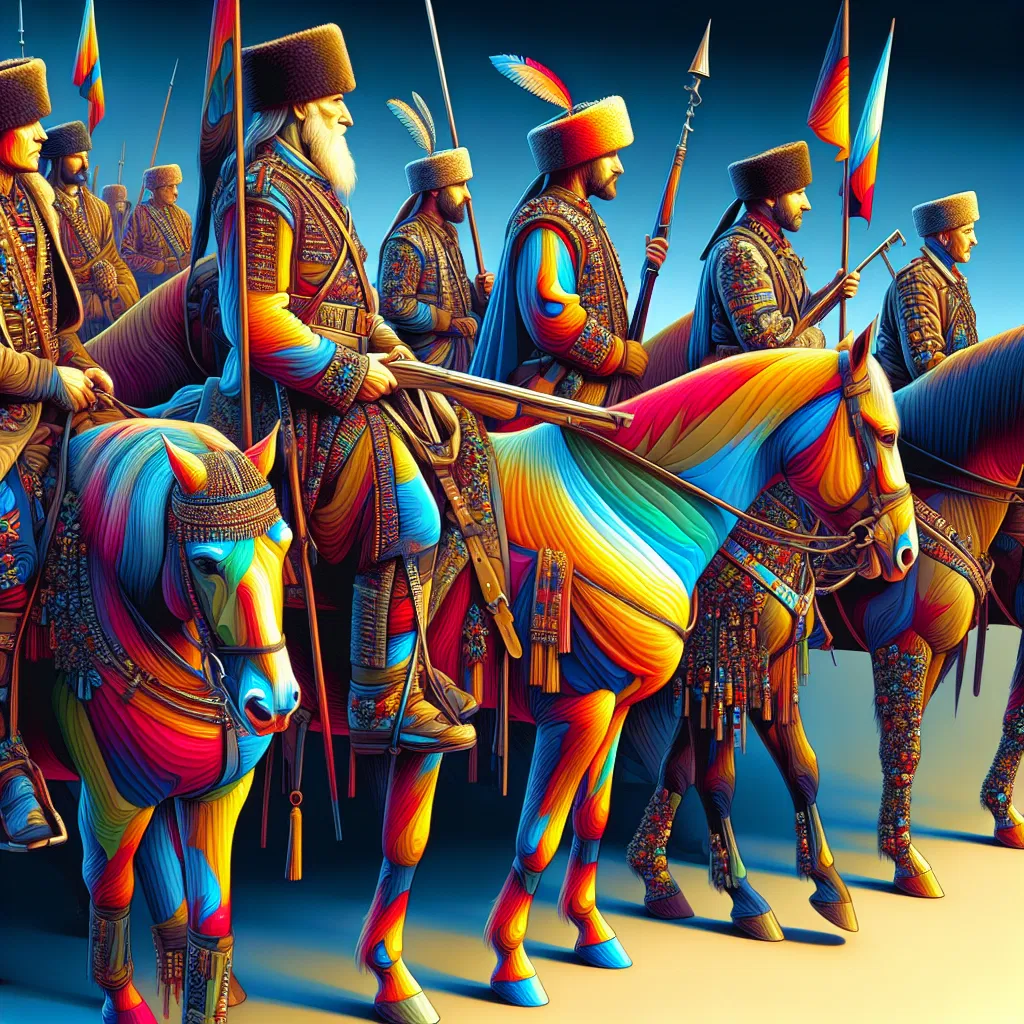

The Ukrainian Registered Cossacks: Guardians of Tradition and Freedom
Imagine a group of fierce warriors, known for their horseback skills and democratic principles, who have played a pivotal role in shaping the history of Eastern Europe. The Ukrainian Registered Cossacks, a legendary military and social class, emerged in the 16th century in the territories of modern-day Ukraine. They were officially recognized by the Polish-Lithuanian Commonwealth in 1572, when King Sigismund II Augustus registered a select number of Cossacks to serve as a military force. This registration marked the beginning of a unique relationship between the Cossacks and the state, as they became both protectors and challengers of authority. The Cossacks were stationed primarily in the Dnieper River region, where they defended the borders against Tatar invasions and sought autonomy from oppressive rulers.
The Cossacks were not just warriors; they were a community bound by a strong sense of identity and tradition. They lived in semi-autonomous communities called "Sich," which were governed by democratic principles. Every member had a say in the decision-making process, and leaders were elected based on merit rather than birthright. This egalitarian structure was revolutionary for its time and attracted many peasants and serfs seeking freedom from feudal oppression. The Cossacks' commitment to liberty and self-governance resonated with the broader Ukrainian population, who saw them as symbols of resistance against foreign domination.
However, the relationship between the Cossacks and the ruling powers was complex and often fraught with tension. While the Polish-Lithuanian Commonwealth initially sought to harness the Cossacks' military prowess, it also attempted to control and limit their influence. The Cossacks, fiercely protective of their autonomy, frequently clashed with the Commonwealth over issues such as religious freedom and social rights. These tensions culminated in several uprisings, the most notable being the Khmelnytsky Uprising of 1648, which was led by the charismatic Cossack leader Bohdan Khmelnytsky. This rebellion not only challenged Polish authority but also laid the groundwork for the eventual establishment of a Cossack state.
The legacy of the Ukrainian Registered Cossacks is a testament to their enduring spirit and influence. Their struggle for autonomy and justice has left a lasting impact on Ukrainian culture and identity. Today, the Cossacks are celebrated as national heroes, and their traditions are preserved through cultural festivals and reenactments. The Cossack ethos of freedom and democracy continues to inspire Ukrainians in their ongoing quest for sovereignty and self-determination.
While the Cossacks are often romanticized as noble warriors, it's important to acknowledge the complexities of their history. They were not a monolithic group, and their actions were sometimes contradictory. For instance, while they fought for freedom, they also engaged in raids and conflicts that could be brutal and destructive. Understanding these nuances is crucial in appreciating the full scope of their legacy.
In contemporary Ukraine, the spirit of the Cossacks lives on in the country's ongoing struggle for independence and democracy. The Cossacks' emphasis on self-governance and resistance against oppression resonates with the current political climate, where Ukrainians continue to assert their right to self-determination in the face of external pressures. The Cossacks serve as a reminder of the power of collective action and the importance of standing up for one's beliefs.
The story of the Ukrainian Registered Cossacks is a fascinating chapter in the history of Eastern Europe. Their legacy is a blend of valor, tradition, and the relentless pursuit of freedom. As Ukraine navigates its path forward, the Cossacks' enduring influence serves as both a source of inspiration and a reminder of the complexities of history.