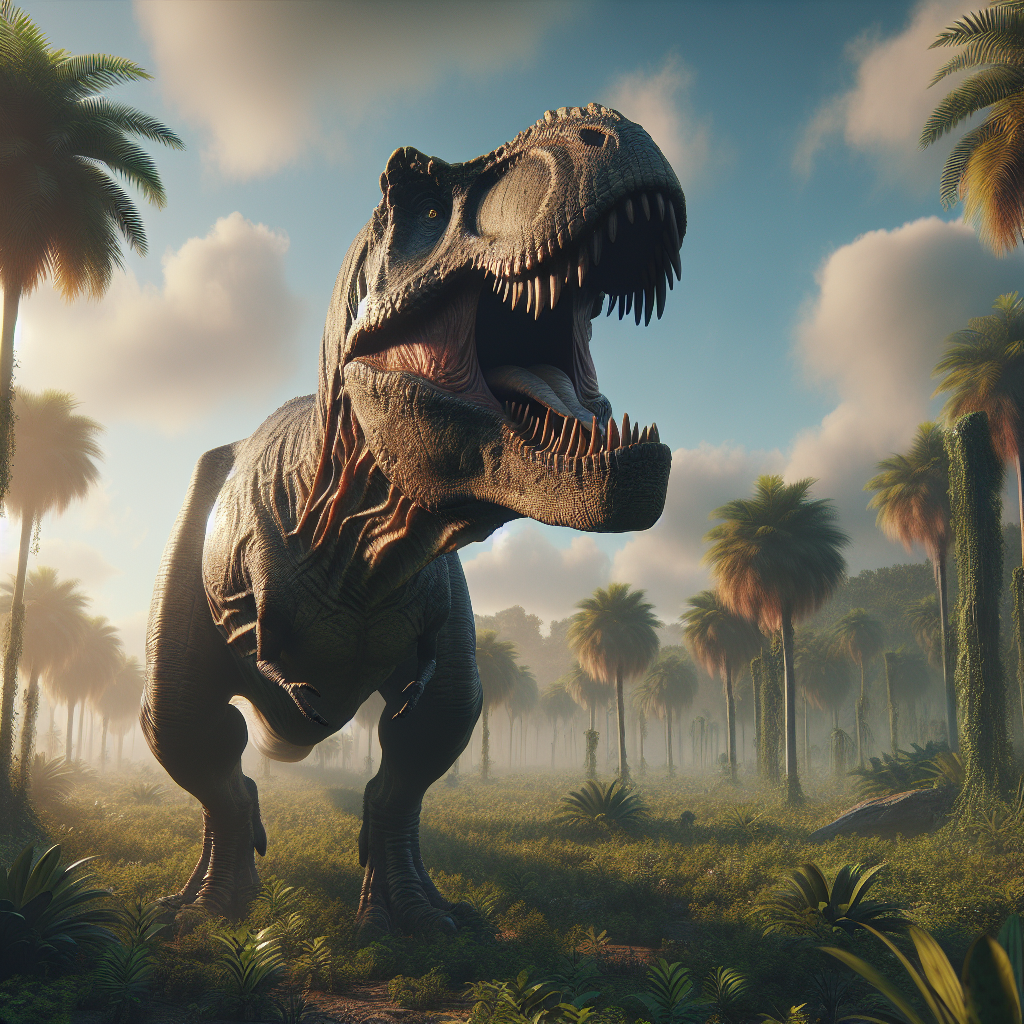

Imagine stepping into a world where the mighty Tyrannosaurus Rex is alive and well, roaring with power and grandeur—well, that's precisely what 'T-Rex: Back to the Cretaceous' invites you to envision. Released in 1998, this groundbreaking film, directed by Brett Leonard, leveraged science, imagination, and the revolutionary new medium of IMAX 3D to transport viewers back to the time when dinosaurs ruled the Earth. Explored through the curious eyes of protagonist Ally Hayden, a young and aspiring paleontologist portrayed by Liz Stauber, the movie premiered at IMAX theaters and captured the hearts of dinosaur lovers worldwide. Its aim was to educate and entertain, but it also sparked significant conversations around the portrayal of prehistoric life in media.
The movie centers around Ally's accidental journey through time, after encountering a mystical amulet during a museum visit. Her adventures lead her face-to-face with vividly depicted dinosaurs, including the iconic T-Rex. The film attempts to weave scientific understanding with a splash of fantasy, balancing the factual with the whimsical. Ally's adventures provide a narrative structure, but the stars are the dinosaurs themselves, brought to life using cutting-edge technology that was quite a spectacle in the late '90s.
T-Rex: Back to the Cretaceous is more than a visual feast; it's a commentary on human curiosity and the quest for knowledge. The film was one of the first to show realistic dinosaurs in an immersive 3D format that seemed to pop right out of the screen. It offered a thrilling experience, especially for younger audiences, fuelling imaginations and perhaps inspiring future scientists and paleontologists. Through the eyes of young Ally, viewers embarked on a journey that was intense, educational, and challenging, prompting them to question and learn.
This film also indirectly highlighted the challenges and controversies in how we reconstruct and interpret prehistoric life. While some scenes were based on scientific understanding and fossil records, others took creative liberties. This balance can sometimes lead to misunderstandings, as the boundary between fact and fantasy blurs. Critics often debate the responsibility of filmmakers in maintaining scientific accuracy while also engaging audiences, especially impressionable ones.
On the flip side, a fantastic element can draw a broader audience to otherwise academic topics. Dinosaurs are inherently fascinating, and adding a fantasy layer can create a more relatable story. It humanizes prehistoric giants, making them accessible to all ages. This is where the film finds its strength, creating cultural and educational dialogues that go beyond the theater.
The visual effects of the film deserve notable mention. For the time, the detailed CGI combined with IMAX 3D technology was revolutionary. It was a pioneering attempt to bring dinosaurs to life in a way that audiences could literally reach out and 'touch'. This approach paved the way for future films in its genre. Although made over two decades ago, its ambition and execution still resonate today.
However, not all viewers might have appreciated the film's blend of science and entertainment. Skeptics argue that it simplifies complex scientific realities, potentially leading to misconceptions. Importantly, creators of such films are constantly evaluating the balance between fueling imaginations and grounding them in reality. But it's undeniable that achieving a major technological feat has always been crucial in driving forward both storytelling and science-related education. As we've seen with other media adaptations—like the Jurassic Park franchise—public curiosity about dinosaurs often leads to deeper engagements with paleontology and science.
Despite criticisms, 'T-Rex: Back to the Cretaceous' remains a revolutionary film. Its ability to spark interest in young minds illustrates how entertainment can be a powerful educational tool. It invites discussions about what we know and don’t know about dinosaurs, ultimately paving a road to curiosity-driven learning.
The film underscores the potential of creative media as a bridge between complex scientific concepts and the public. Its blend of fear, excitement, and wonder provides an important cultural touchstone that encourages audiences to ask questions, seek understanding, and engage with science critically.
This exploration of prehistoric life through 'T-Rex: Back to the Cretaceous' speaks to a broader issue of how we communicate science to generations more inclined to believe visual media over textbooks. In a rapidly changing world, blending education with technology and entertainment might be crucial for fostering scientific literacy. And even if some argue that science takes a backseat in such depictions, the excitement and wonder it can inspire should not be understated. The conversations sparked by this balance of fact and fiction are vital in keeping the public—especially younger generations—engaged with science. After all, excitement is often the first step towards knowledge, and a film like 'T-Rex: Back to the Cretaceous' holds the power to ignite both.