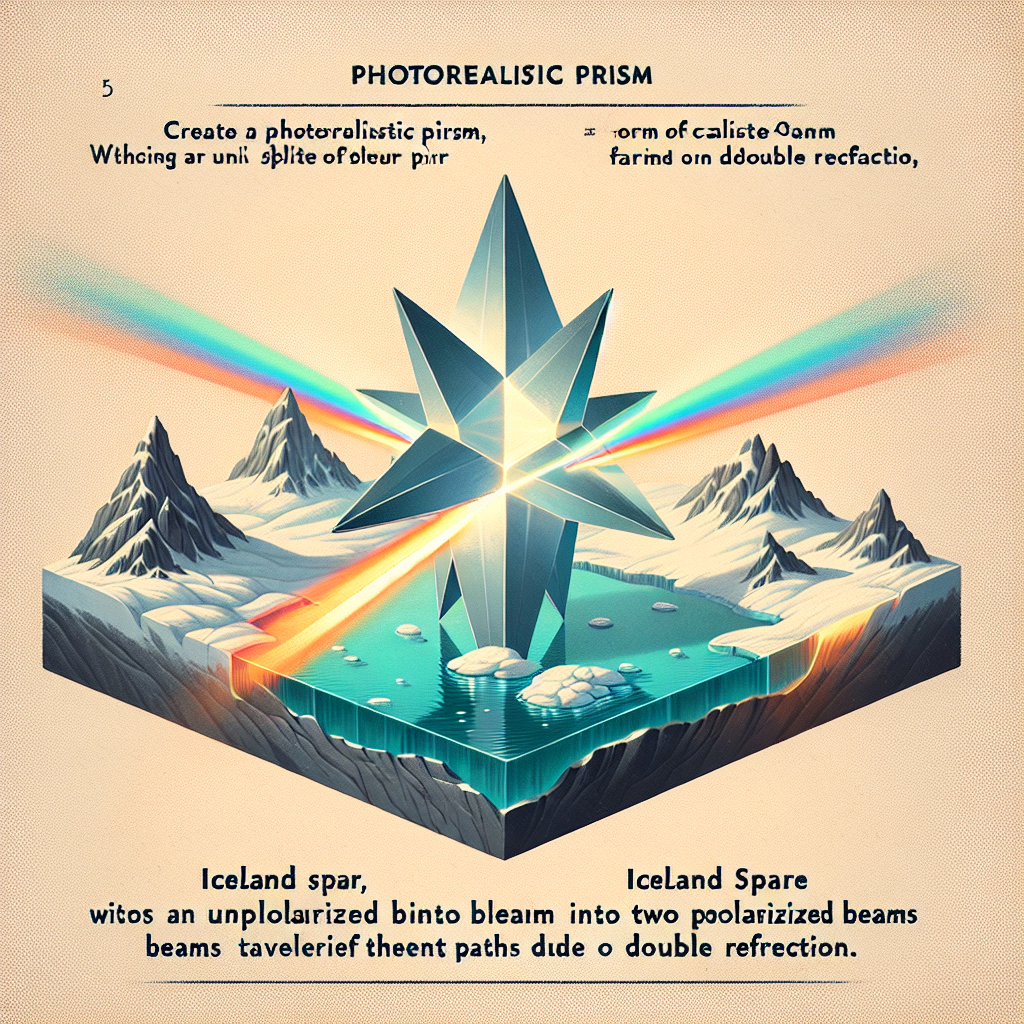

Ever wondered if everyone sees the world the same way you do? Well, it turns out some people see it through a Nicol prism! Invented in the vast landscape of 19th-century optics by William Nicol, this intriguing device is not as complex as it sounds. It's actually a cornerstone of polarized light applications. Picture yourself in Edinburgh, Scotland, in 1828, where Nicol first cracked the code to splitting light in a world increasingly obsessed with understanding it. The purpose? To trick light, making it dance in ways it wouldn't naturally do.
Here's the deal: a Nicol prism is constructed by cementing two calcite crystal halves, cut at an angle, with a layer of Canada balsam — think of it as nature's glue. This ingenious setup allows light to pass in a polarized manner. Simply put, when unpolarized light enters the prism, it splits into two beams inside, sending out only the extraordinary beam and leaving its ordinary companion behind. It's like an exclusive optical party where only the E-VIPs make it through.
So why did Nicol bother to invent this? At its heart, the Nicol prism was about polarizing light, a process that helps in reducing glare and giving us clear, vibrant visuals. Fast forward to today, and you'll find this principle inside literally every place you look, from movie-making magic to cutting-edge research in labs. Using polarized light is hugely beneficial. It allows improved contrast and material analysis in microscopes. It even finds its way into fancy sunglasses that give you a clearer, glare-free view.
It's easy to imagine such inventions getting buried in dust in a world that moves faster than light sometimes. However, the Nicol prism still holds its ground because of how simple yet effective it is. Polarization opens doors to understanding stress patterns in materials and creating 3D visual experiences, something Nicol likely never dreamed of. Yet, with technology taking massive leaps, some might argue for newer alternatives over tried and true devices. While electric polarization gadgets make everything look slicker, Nicol's creation doesn't require a power source, making it a reliable backup even when batteries die out.
Some skeptics argue that Nicol prisms are too niche nowadays, more suited for special environments like laboratories. In today's consumerist culture and with sustainable tech on the rise, innovations are all about reducing waste and saving energy. New technologies aim to use less material or integrate blockchain solutions for transparency in supply chains. But consider this: technological advancements often rest on the shoulders of simpler discoveries. There's a romantic charm to a Nicol prism — a piece of pure ingenuity that whispers of a time when one could turn a mundane piece of crystal into something illuminating.
Looking at the Nicol prism with a modern lens shows us it’s more than just a relic. It stands as a philosophical testament to human curiosity and the pursuit of clarity in an ever-complex world. It nods to our roots while we gaze at stars (or screens) and reminds us that sometimes the simplest solutions may indeed be the most enduring. Who would have thought a humble prism could shed light on both optics and life itself?
For Gen Z readers navigating their world, the Nicol prism is a metaphorical torch, symbolizing how seeing things differently — or polarizing them — might just clear paths in self-exploration and social change. In a time rampant with information overload, questioning what we see and how we see it remains ever-relevant. In your own life, think about what concepts you can “polarize,” what angles you can look from to deepen understanding or discover new insights.
William Nicol may not have anticipated the cultural and scientific ripple effects of his prism, but his work continues to illuminate — both literally and figuratively. Such inventions remind us that sometimes, the universe knits the seemingly mundane with threads of brilliance. Next time you pop on a pair of sunglasses or thrill at a 3D movie, spare a thought for Nicol’s prism. It's a small yet crucial piece of the global tapestry, proving that in seeing differently, we might just discover clarity.