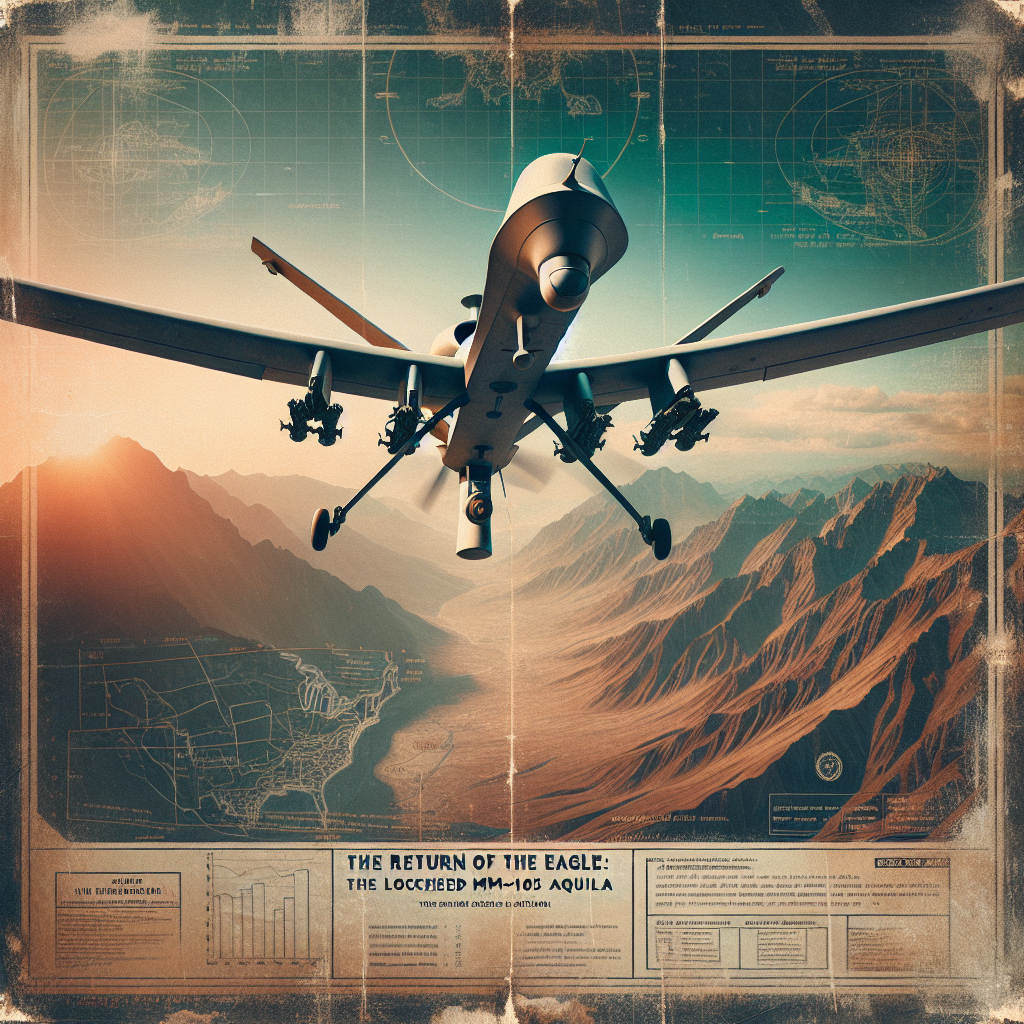

The Lockheed MQM-105 Aquila was not your typical drone story. Born in the ambitious era of technological leaps and campaigns for innovative military tools, the Aquila was envisioned as an advanced battlefield UAV (unmanned aerial vehicle), christened with the potential to change the way we think about reconnaissance. Conceptualized and developed by Lockheed in the 1970s, the project was groundbreaking, aimed primarily at giving the U.S. Army eyes in the sky. Despite its promise, though, the journey of the Aquila was far from smooth or particularly successful, showing how even forward-thinking ventures can meet incongruous realities.
This flashy drone kicked off its story with a promising angle – it was meant to enhance battlefield operations and give tactical advantage from a high-flying perspective. We find ourselves in an era where technological pushes were driven by cold war dynamics and rapid advances in electronic ingenuity. Despite rich investment from the U.S. Defense Department, Aquila's journey turned rocky fairly quickly, entangled in a network of testing failures and cost overruns.
As with many ambitious projects, various contributing factors played into its troubled trajectory. Its intended environment featured treacherous skies and evolving ground warfare tactics, compounded by the technical demands posed by its innovation. The stakes were high, and expectations were breathlessly set. Engineers aimed to produce a stealthy, durable craft able to fly unnoticed amid the chaos of battle.
Political landscapes and technological barriers often jostle for center stage in narratives like this one. By the time the Aquila was being tested in the early 1980s, its challenges were crystallized. It attempted to incorporate groundbreaking technologies, which included sophisticated navigation systems and real-time data links that were rather novel for its time. Yet, ironically, these same features became its Achilles' heel. During the tests, the Aquila often struggled with reliability, as the components required for its complex tasks sometimes couldn’t deliver consistent performance.
It’s not hard to imagine the level of investment and expectation channeled into the Aquila. However, the project became notorious for its spiraling costs and technical hiccups. It’s all too relatable a scenario – envisioning a future so breathtaking, only to watch it falter under the weight of uncontrollable circumstances. Opinions were sharply divided over the Aquila's worth and prospects. To its champions, it symbolized innovation and the future of military reconnaissance, an emblem of promise and potential. But for critics, it became emblematic of imprudent spending and bureaucratic entanglements.
Cancelation seemed inevitable. By 1987, after hefty financial infusions – in tune with billions of today’s dollars – the U.S. Army finally grounded the Aquila project for good. Debates stir on whether this decision was pegged more on fiscal rationality or technical impracticality. Was the Aquila victimized by the harsh whirlwind of technological limitations and escalating demands, or was it doomed by systemic inefficiencies hardwired into defense projects of the era?
Meanwhile, from an alternate perspective, the Aquila did carve out a legacy, albeit unwittingly. Even as the project was shuttered, its core learnings didn’t evaporate into thin air. Lessons absorbed from its failures fed into future UAV operations and designs. The challenges it encountered – such as testing new sensory inputs, overcoming data transmission issues, and adapting structural designs – have echoed in the evolution of more successful UAVs.
In today's fast-paced era, the Aquila’s story serves as a reminder of the double-edged sword of innovation. It resonates with our generational hunger for faster, smarter solutions while reminding us of pragmatic restraints. Governments’ use of funds, especially in areas like defense, continuously draws scrutiny. As we chase after scientific advancements, there’s a palpable expectation for responsible expenditure and tangible outcomes, a culture Gen Z is no stranger to endorsing with a keen eye on sustainability and accountability.
Broadly speaking, the Lockheed MQM-105 Aquila can be viewed as a story of ambition met with the unyielding hands of fate. Initially cloaked with high expectations, its unraveling is a tale where technological aspiration meets the hard truths of execution. Be it a story of thwarted success or a lesson-laden journey passed on to successive innovations, the Aquila remains etched in history. Its journey, like many others, is complex, leaving one wondering about the nature of progress, the do-or-die spirit of tech development, and the indelicate dance between vision and reality.