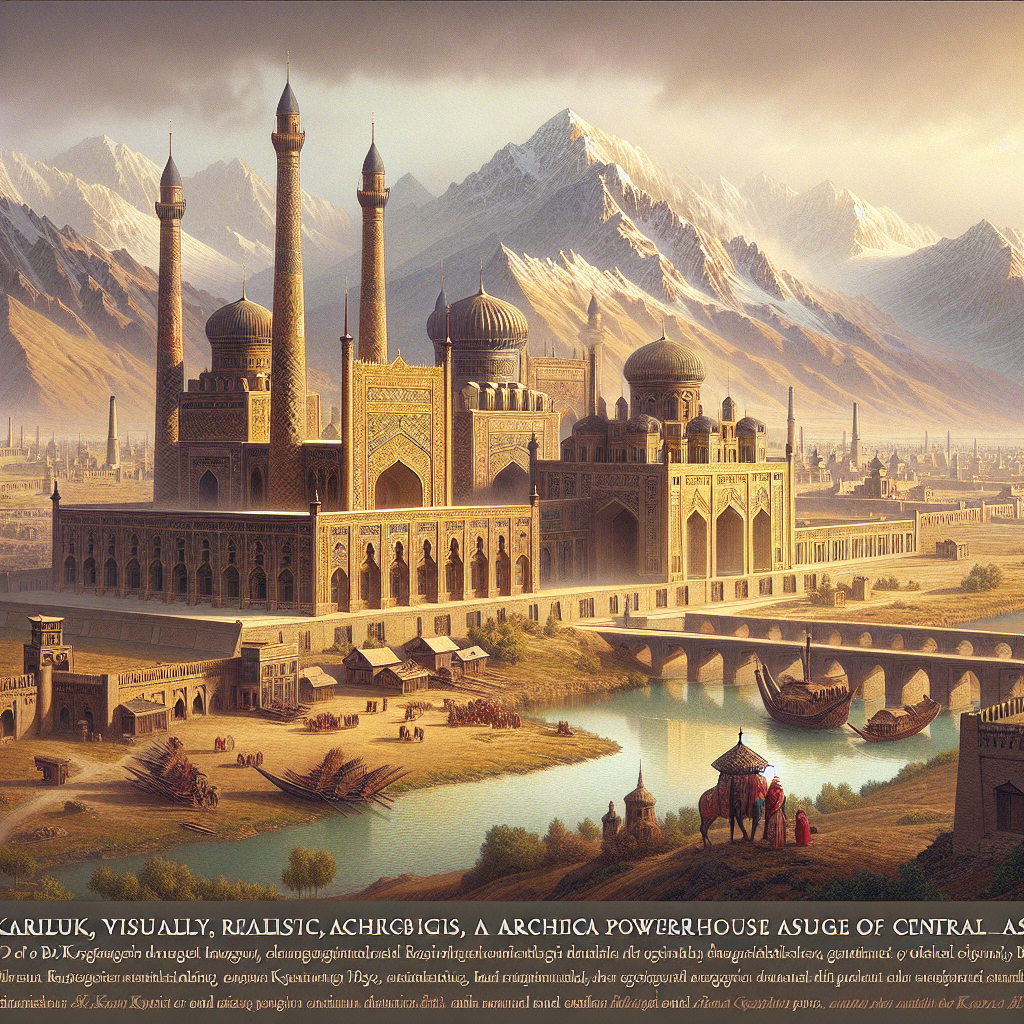

Imagine a time when power wasn't defined by lines drawn on a map but by the strength of your troops and the wisdom in your council. In the expansive epoch of the early medieval era, the Karluk Yabghu was a fortifying tribal union of Central Asia, commanding respect and intrigue. Formed around the 7th century, the Karluk Yabghu reigned in a region that today spans parts of Kazakhstan and Kyrgyzstan. It arose in an era when the world was rife with emerging powers, ruthless yet visionary leaders, and profound cultural exchanges. This tribal confederation set up a formidable network, fostering intense trading relationships and engaging in dynamic cultural interplay.
The Karluks were Turkic people with a nuanced historical identity, serving as harbingers of change during a crucial period. They were part of the Göktürk Khaganate but took advantage of political fractures within that entity to foster their autonomy. The title 'Yabghu' itself is a Turkic honorific meaning a kind of vice-regent or viceroy. It implies leadership that combines localized autonomy with allegiance to a broader political framework, which was characteristically pluralistic and inclusive of multiple tribes. Their strategic location along the Silk Road, the legendary trade network, not only enriched their coffers but also exposed them to various cultures and religions, all aiding in the evolution of a complex societal structure.
Amidst the shifting tides of power, the Karluks knew they had to straddle the fine line between force and diplomacy. Their leadership was savvy in forming alliances with the Tang dynasty of China and the Abbasid Caliphate of the Islamic Golden Age, illustrating a balance of ingenuity and pragmatism. The Karluk's fusion of cultures didn't just stop at commerce or robust political frameworks; it extended into adopting the Arab script and eventually Islam, facets that reshaped their identity.
As rulers, the Karluks had to navigate a polymorphous terrain of alliances and enmities. History tells us that they aligned with the Umayyad forces at some points, while at others, they found themselves antagonistic. It was an era of realpolitik where practical concerns often trumped ideology. Such decisions often spark debate today, with opinions diverging between seeing them as opportunists or adaptable, visionary leaders.
Not everyone may glamorize the significance they held. Viewed through a more critical lens, some could argue that the Karluk reliance on foreign trade and alliances exposed them to vulnerability and cultural erosion. In times of cultural purism, blending varied influences sometimes meets with skepticism. Yet, examining the tapestry of Karluk Yabghu's landscape with empathy highlights a culture that thrived not despite its diversity but because of it.
Their organizational efficiency cannot be understated. The Karluks effectively used their tribal confederation status to manage a multi-ethnic coalition, which some modern-day governance systems struggle to emulate. With a keen understanding of political geography, they laid the groundwork for regions where diversity was seen as strength rather than a hindrance. However, this inclusion occasionally entailed internal strife, an unavoidable outcome when governing a tapestry of tribal identities.
With the coming of Islam as a dominant influence by the 9th century, the Karluk identity morphed yet again, absorbing Islamic artistic and scholarly advancements. Their engagement with cultures along the Silk Road brought in not just luxury goods but artisans, scholars, and thinkers, forming a polyphonic mix of ideas and innovations. Their legacy involves a contribution to what we acknowledge as the extraordinary cultural diffusion along this historical route.
For young people today—especially those interested in how cultural interactions have shaped, and continue to shape, societies—Karluk Yabghu offers fascinating insights. It challenges us to look beyond the confines of modern borders and engage with history's nomads as architects of past globalism. As identity politics dominate contemporary discourse, understanding the Karluk confederation urges us to reflect on coexistence as a mode of thriving, not just surviving.
Both their achievements and vulnerabilities impart lessons on how we may approach current debates around multiculturalism, immigration, and global alliances. Acknowledging their history invites a discussion about today's interconnected world. What if we viewed cultural fluidity not as a threat but as an enriching force? The Karluk legacy challenges boundaries and norms, accepted or resisted, to craft narratives about who we are and what shapes us as societies.
History can often be a collection of stories told by victors, yet the Karluk Yabghu managed to etch their chapter into the archives of time through resilience, adaptability, and unfinished dialogues. The beauty—and perhaps the greatest lesson—of their story lies in understanding how community dynamics and perspectives are ever-fluid, molded by those willing to engage rather than retreat.