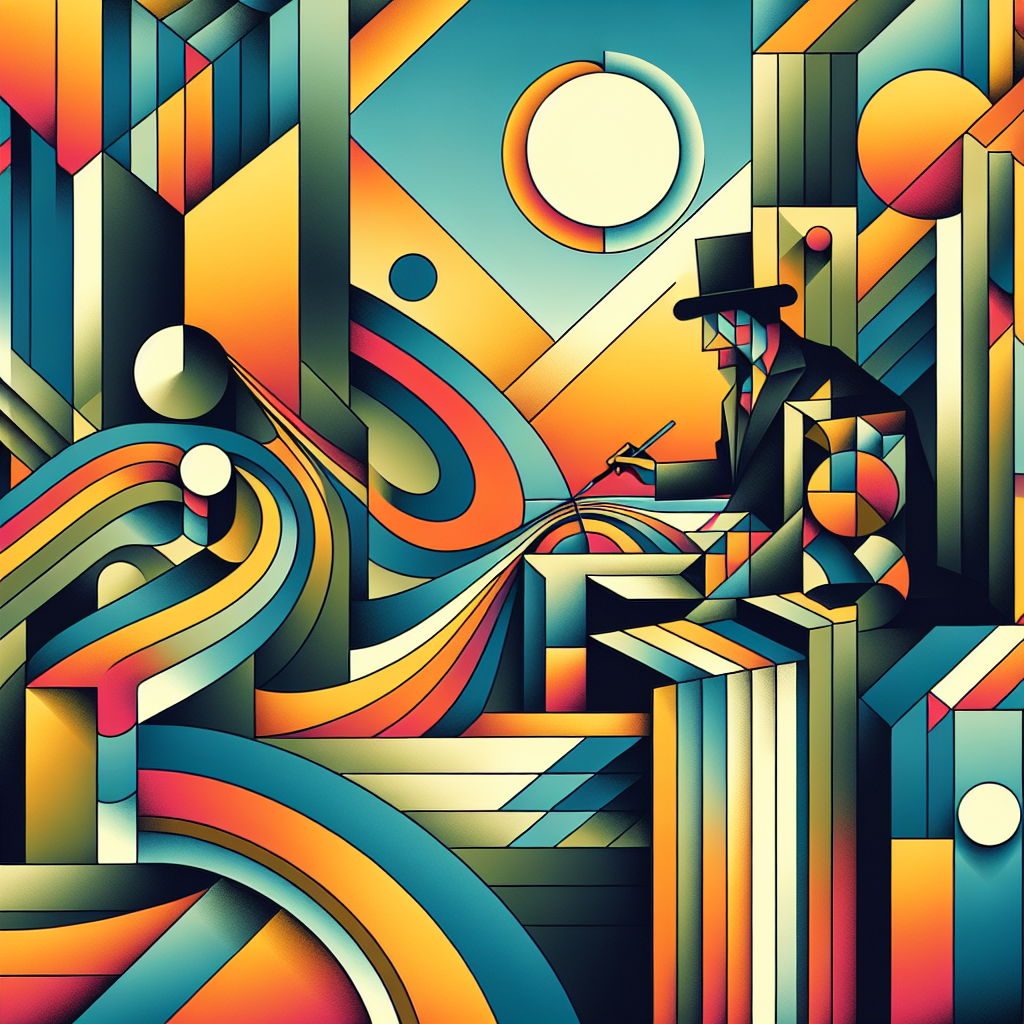

Friedrich Vordemberge-Gildewart: The Abstract Pioneer You Never Knew You Needed
Imagine a world where art is stripped down to its bare essentials, where lines, shapes, and colors dance in harmony without the clutter of realism. This is the world of Friedrich Vordemberge-Gildewart, a German artist who played a pivotal role in the abstract art movement during the early to mid-20th century. Born in 1899 in Osnabrück, Germany, Vordemberge-Gildewart was a trailblazer in the realm of non-objective art, a style that eschews recognizable subjects in favor of pure abstraction. His work spanned several decades, with his most influential pieces emerging between the 1920s and 1960s, primarily in Europe. He was a key figure in the avant-garde movement, contributing to the development of Constructivism and Concrete Art, which sought to create art that was free from the constraints of traditional representation.
Vordemberge-Gildewart's journey into the world of abstract art began in the aftermath of World War I, a time when many artists were seeking new ways to express the chaos and disillusionment of the era. He initially studied architecture and interior design, which influenced his precise and geometric style. His early works were characterized by a meticulous arrangement of forms and colors, reflecting his belief in the power of art to convey universal truths through simplicity and order. This approach resonated with the Constructivist movement, which emphasized the use of geometric shapes and a limited color palette to create art that was both functional and aesthetically pleasing.
Despite his significant contributions to the art world, Vordemberge-Gildewart's name is not as widely recognized as some of his contemporaries, such as Piet Mondrian or Wassily Kandinsky. This is partly due to the political climate of the time. The rise of the Nazi regime in Germany forced many avant-garde artists to flee the country, as their work was deemed "degenerate" and incompatible with the regime's ideals. Vordemberge-Gildewart relocated to the Netherlands, where he continued to create and exhibit his work, albeit with less visibility than he might have had in a more supportive environment.
Vordemberge-Gildewart's art is a testament to the power of abstraction to transcend cultural and political boundaries. His compositions, often consisting of simple geometric shapes arranged in dynamic and harmonious ways, invite viewers to engage with the artwork on a purely visual level. This focus on form and color allows for a universal appreciation of his work, as it does not rely on specific cultural references or narratives. In this way, Vordemberge-Gildewart's art can be seen as a precursor to the minimalist movement that emerged in the latter half of the 20th century, which similarly sought to strip art down to its essential elements.
While some critics argue that abstract art lacks the emotional depth and narrative complexity of more traditional forms, Vordemberge-Gildewart's work challenges this notion by demonstrating that simplicity can be just as powerful as complexity. His art encourages viewers to find meaning in the relationships between shapes and colors, rather than in the depiction of recognizable subjects. This approach not only democratizes art by making it accessible to a wider audience but also invites viewers to engage with the artwork in a more personal and introspective way.
For those who appreciate the beauty of simplicity and the power of abstraction, Friedrich Vordemberge-Gildewart's work offers a refreshing perspective on the possibilities of art. His legacy as a pioneer of abstract art continues to inspire artists and art enthusiasts alike, reminding us that sometimes, less truly is more. As we navigate an increasingly complex world, Vordemberge-Gildewart's art serves as a reminder of the beauty and clarity that can be found in simplicity, encouraging us to look beyond the surface and appreciate the underlying harmony that exists in all things.