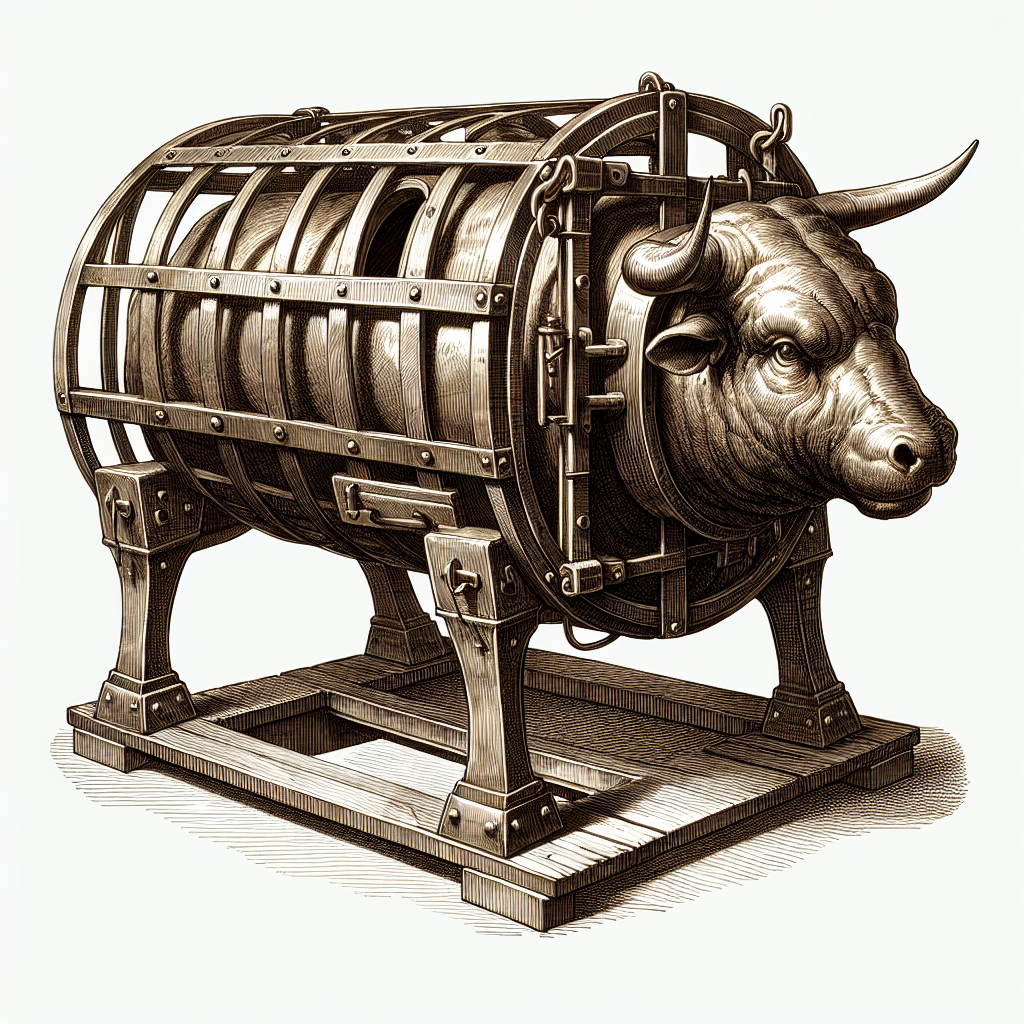

Imagine being roasted alive in a bronze bull designed to turn screams into musical symphonies. Welcome to ancient Greece, where cruelty was an art form. The Brazen Bull was crafted in the 6th century B.C. by the artisan Perilaus of Athens for Phalaris, the tyrant of Akragas in Sicily. This gruesome device was a hollow, life-sized bull made entirely of bronze, complete with an interior chamber and an intricate sound system designed to amplify the screams of its doomed occupants. Why such a horrendous invention? Because ancient tyrants had a penchant for making cruelty a spectacle, reminding us that barbarism and power have been bedfellows across the ages.
Step aside, woke masses, and let's dissect why the Brazen Bull is a dark reflection on humanity. First, it stands as a monumental testament to the lengths a totalitarian leader will go to keep their subjects in line. A tyrant like Phalaris didn’t just want submission; he wanted to marinate his power with terror. Western civilization has thankfully moved away from bull-roasting entertainment, yet certain governments today still find subtle ways to keep people in line—hello, cancel culture?
Now, let’s talk about the engineering marvel that is the Brazen Bull. Architects today design skyscrapers; Perilaus engineered a symbol of tyranny. The bull's acoustics were said to transmute a victim's screams into the bellowing of an enraged bull, turning human suffering into a twisted form of music. It’s almost like a precursor to modern propaganda techniques where the truth is twisted to fit a narrative.
Let’s not forget the utterly contagious nature of cruelty among rulers. The Brazen Bull allegedly devoured its own creator. According to legend, Phalaris invited Perilaus to "test" his creation, ensuring the first notes of anguish were from its architect. An ironic twist worthy of historical headlines, it reminds us how tools of destruction often betray their creators.
In contemporary society, people love accusing right-leaning folk of harsh policies without understanding historical toughness. The world wasn't always safe spaces and trigger warnings. In Phalaris' era, strength was exhibited through dominance. An apparatus like the Brazen Bull is the dark side of what strength unchecked can become. It’s a necessary component of history that shows how unchecked power leads to madness.
For a moment, think of how modern society might react if such a contraption were uncovered. Historical relics often spark debates about how far we have come as a civilization. But there’s a curious fascination, especially when we look at societies so accustomed to avoiding discomfort. For anyone screaming that today’s world is the pinnacle of oppression, the Brazen Bull sits as a grim reminder of what true totalitarianism entails.
The Brazen Bull is also an interesting study in the notion of justice and consequences. When looking back at instances like this, modern civilization can nod knowingly at its evolved sense of human rights and justice. But before getting too comfortable on this moral pedestal, consider the ways society metaphorically roasts individuals through trial by social media. We may not have a physical bull today, but the mechanisms of public judgment and spectacle remain eerily reminiscent.
Ultimately, the Brazen Bull is an eerie reflection of human nature's darker impulses. It’s no comfort blanket to remember, but history like this serves as a harsh warning. Societies that lose themselves in unchecked leadership and brutal enforcement are merely reflections of what once was. The stories of the past often mirror aspects of the present, showing us where we risk repeating old follies. Pretending to learn from history while ignoring its harsh truths only places us on the precipice of making the same mistakes.
And for anyone ready to argue that modern society is beyond this brand of barbarism, consider: is it truly distant, or have the methods merely evolved? In the land of free speech being muzzled and differing opinions branded dangerous, control doesn’t always come from the barrel of a gun or the belly of a bull. Sometimes it’s more insidious, creeping into policies that masquerade as morality.
The Brazen Bull stands as a testament to endurance through fear. Men like Phalaris wielded cruelty like an artist wields a brush, crafting a significant metaphor for discussing politics and power dynamics. In a world obsessed with being the victor of the social landscape, perhaps the bull’s horns are closer than one might think.