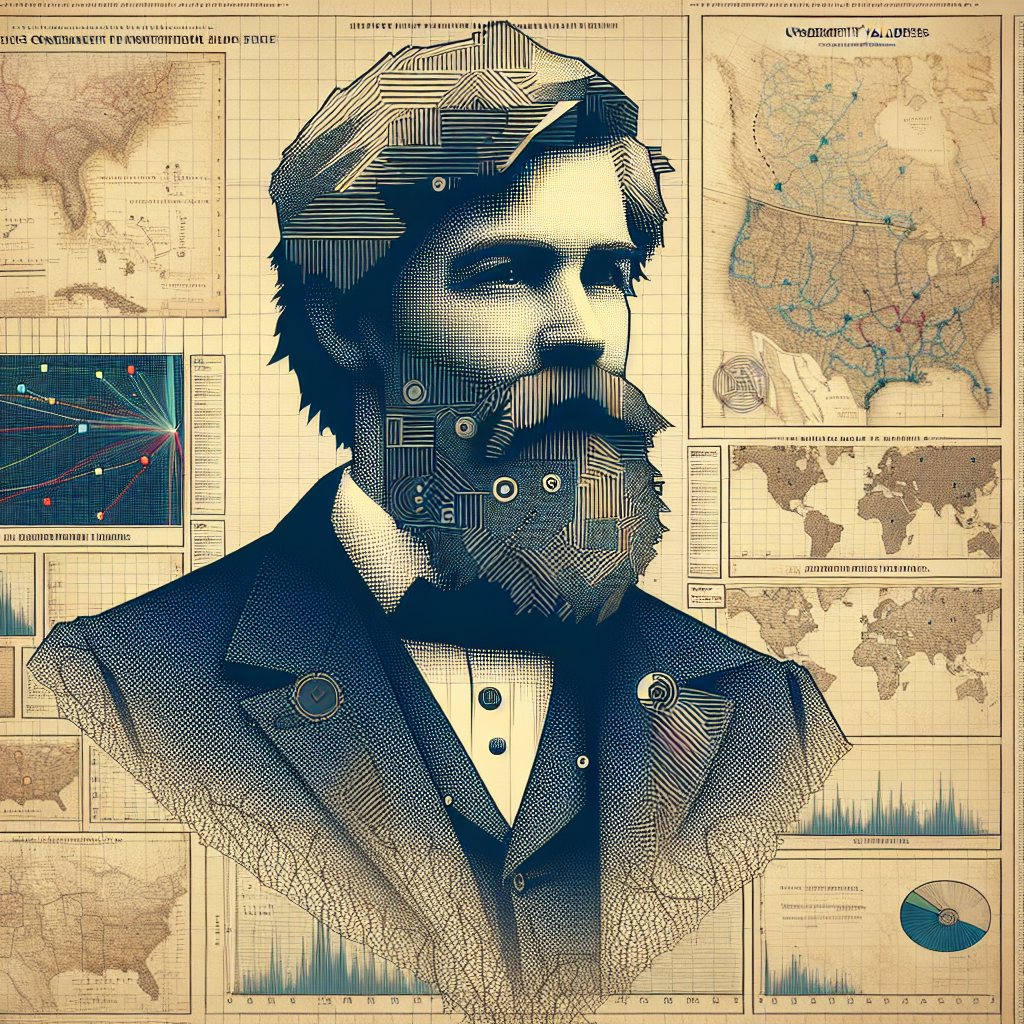

Did you know that there once was a man who seamlessly blended the realms of politics, diplomacy, and science? That man was William Waddington, a key figure in 19th-century Europe, whose story is an exemplary tale of intellect and optimism. Born in 1826, Waddington was a French statesman, serving as Prime Minister of France, but his influence extends far beyond political borders.
From England to France, and from the scientific arenas to the corridors of power, Waddington's life is a fascinating journey. He was the son of a wealthy industrialist, living in an interconnected world where he contributed massively to the fields he navigated. But what makes William Waddington's story even more interesting is not just the positions he held, but the dynamic contribution he made to historical, scientific, and international relations legacies.
Early Life and Education
William Henry Waddington was born in Saint-Rémy-sur-Avre to an English family deeply rooted in the industrial sector. His father, Thomas Waddington, was involved in textiles, and it seemed only natural that young William would follow in solid societal footsteps. Instead, he pursued knowledge with relentless enthusiasm.
Educated initially in England, Waddington crossed the Channel to study at the École Normale Supérieure in Paris, one of France’s élite educational institutions. Education in France was an exhilarating period for Waddington, where the burgeoning ideas of democracy, science, and technology ripened his appetite for distinct fields of study, tying various strands of human progress together.
Scientific Pursuits
Waddington was not just absorbed in the political sphere; he had a profound love for archaeology. He embarked on several expeditions, particularly focusing on ancient Greek archaeology, making significant contributions. His work took him across the broad and breath-taking landscapes of Asia Minor, allowing him to uncover Greek antiquities and contribute to the nascent field of archaeology.
He even authored the notable "Voyage Archéologique en Grèce et en Asie Mineure," a comprehensive chronicle that intrigued fellow scholars and enthusiasts alike. For Waddington, science was a beautiful, endless relay where each discovery was another step towards a greater understanding of humanity’s past.
Political Journey
After building a foundation in both academic and scientific fields, Waddington turned his gaze towards politics—an arena where he could marry his empirical reasoning with national service. Waddington climbed the ranks to become France's Minister of Education and later, the Minister of Foreign Affairs under President Patrice de MacMahon.
His willingness to bridge science and politics eventually led him to serve as the Prime Minister of France in 1879. During his tenure, Waddington was an advocate for national morale and international harmony. He played a key role in crafting policies that were not just reactive but deeply rooted in strategic vision grounded in scientific inquiry and historical context.
Diplomatic Contributions
Waddington’s diplomatic acumen hissed through European capitals like a cooling breeze on a sweltering day. He took part in the Congress of Berlin in 1878, where intricate European differences over the Balkans were tabled. In this forum of global concatenations, Waddington depicted a seasoned diplomat striving for equilibrium and mutual benefits among nations.
His contribution to European diplomacy during this period has often been likened to a sturdy tree providing shade amidst heated negotiations, always hoping for a future where cooperation and connectivity triumphed over discord.
Legacy and Impact
William Waddington's legacy may seem a patchwork quilt of politics, archaeology, and diplomacy, but it fundamentally revolves around his passion for enhancing human understanding and collaboration. He heartily believed in the interconnectedness of knowledge, a precursor to the interdisciplinary approaches we value today.
His life and career are a template demonstrating how the scientific method, when applied to societal constructs, can lead to era-defining changes and peace. His legacy persists as an emblem of optimism that boldly bridges domains and leans into the power of cumulative knowledge.
Conclusion
The life of William Waddington demonstrates that one should rarely limit themselves to a single path but instead embrace a multitude of interests and inspirations for a richer, buffered existence. He stands as an enduring testament to humanity's thrilling journey towards a unified understanding of our world through science, politics, and history.
William Waddington remains a sterling example in history, cataloging the essence of optimism and learning—a testament to inquiring minds across the globe.