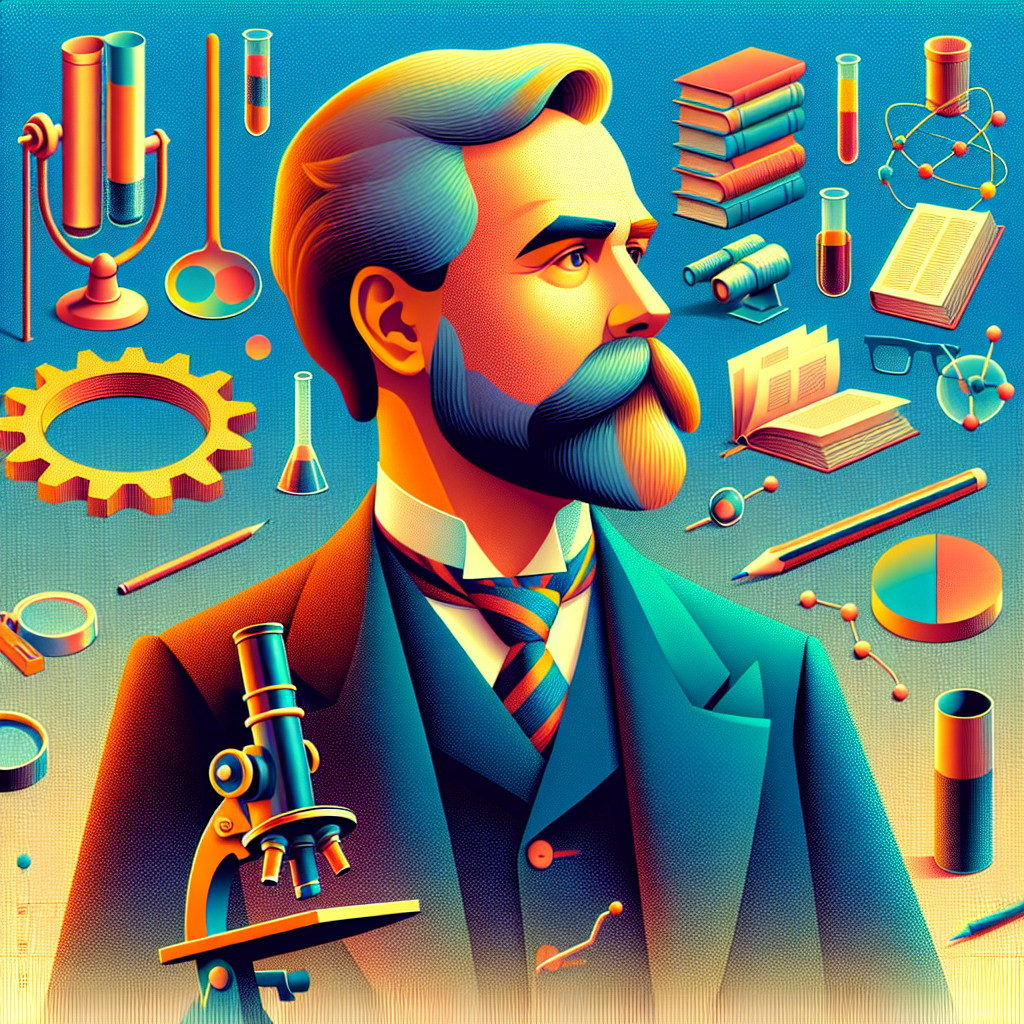

Sir Benjamin Collins Brodie, 2nd Baronet, might not have had a Twitter account, but his life's work in the face of skepticism would have surely trended by now! Born into the scientific revolution of the 19th century on February 5, 1817, in Savile Row, London, Brodie was a prominent chemist who made lasting contributions to the study of organic chemistry and beyond. With a legacy that anchors us in the understanding of chemical reactions, his story is a captivating narrative of curiosity, dedication, and the relentless pursuit of knowledge.
Setting the Stage
As a son to Sir Benjamin Brodie, 1st Baronet, who was a distinguished surgeon and physiologist, it might seem as though young Benjamin was predestined for a scientific path. Educated at Balliol College, Oxford, Brodie was enveloped in an atmosphere of burgeoning scientific inquiry and innovation. Oxford, a vibrant hub of intellectual curiosity, offered Brodie both the inspiration and resources to pursue his burgeoning interest in chemistry and mathematics.
The Science of Change
Brodie's early work focused heavily on chemistry, where he pioneered new approaches to understanding organic compounds. One of his most notable contributions was his calculation of atomic weights, which helped further our understanding of chemical structures. His work in this field was built upon the quantification of matter—a concept so fundamental that today it forms the very basis of stoichiometry, a key tenet in chemistry used to describe the quantitative aspects of chemical reactions.
Perhaps what truly set Brodie apart was his ability to simplify extremely complex chemical phenomena, making them accessible not just to his peers, but to future generations of chemists who followed in his footsteps. His research paved the way for a deeper understanding of chemical reactions, transforming abstract theoretical questions into tangible, empirical science.
A Shift Towards Philosophy
Later in life, Brodie’s interests took a fascinating turn towards the philosophy of science. This transition was marked by his 1862 book, "Calculus of Chemical Operations", which signified a blending of his mathematical acumen with his empirical studies. In this work, Brodie advocated for a more structured and analytical approach to chemistry, much akin to how calculations are used in mathematics.
Brodie's foray into the philosophy of scientific methodologies highlighted his deep respect for a systematic, logical approach to scientific inquiry. He was not content merely with 'what' and 'how' of chemical reactions, but also questioned the very 'why', striving to understand the underlying principles that govern chemical processes.
The Legacy Lives On
Brodie left more than just chemical formulas and philosophical musings. As a fellow of the Royal Society, he was an active member of the scientific community, providing guidance and mentoring to budding scientists of his time. His tenure as the president of the Chemical Society from 1859 to 1861 further solidified his role as a leader in the field.
Sir Benjamin Collins Brodie, 2nd Baronet, remains an exemplar of how interdisciplinary curiosity can fuel scientific advancement—a reminder that in the quest for understanding, boundaries are meant to be crossed. His dual focus on chemistry and philosophy suggests that scientific discovery and human reasoning are not just compatible but interdependent.
An Optimistic View on Interdisciplinary Research
In today's world, where scientific inquiry is more collaborative than ever, Brodie's life embodies an optimistic vision—one where boundaries between disciplines blur, and collaboration leads to innovation. His pursuits remind us that to solve the complex issues of our time, we must look beyond traditional lines and foster an environment where knowledge of the empirical complements the metaphysical.
Brodie's legacy imparts a message of balance: the harmonious blend of science and philosophy, theory and practice. As we push onward in our own exploratory quests, Brodie encourages us to break down complexities into simpler truths, craft new knowledge with curious minds, and always, always, keep asking why.