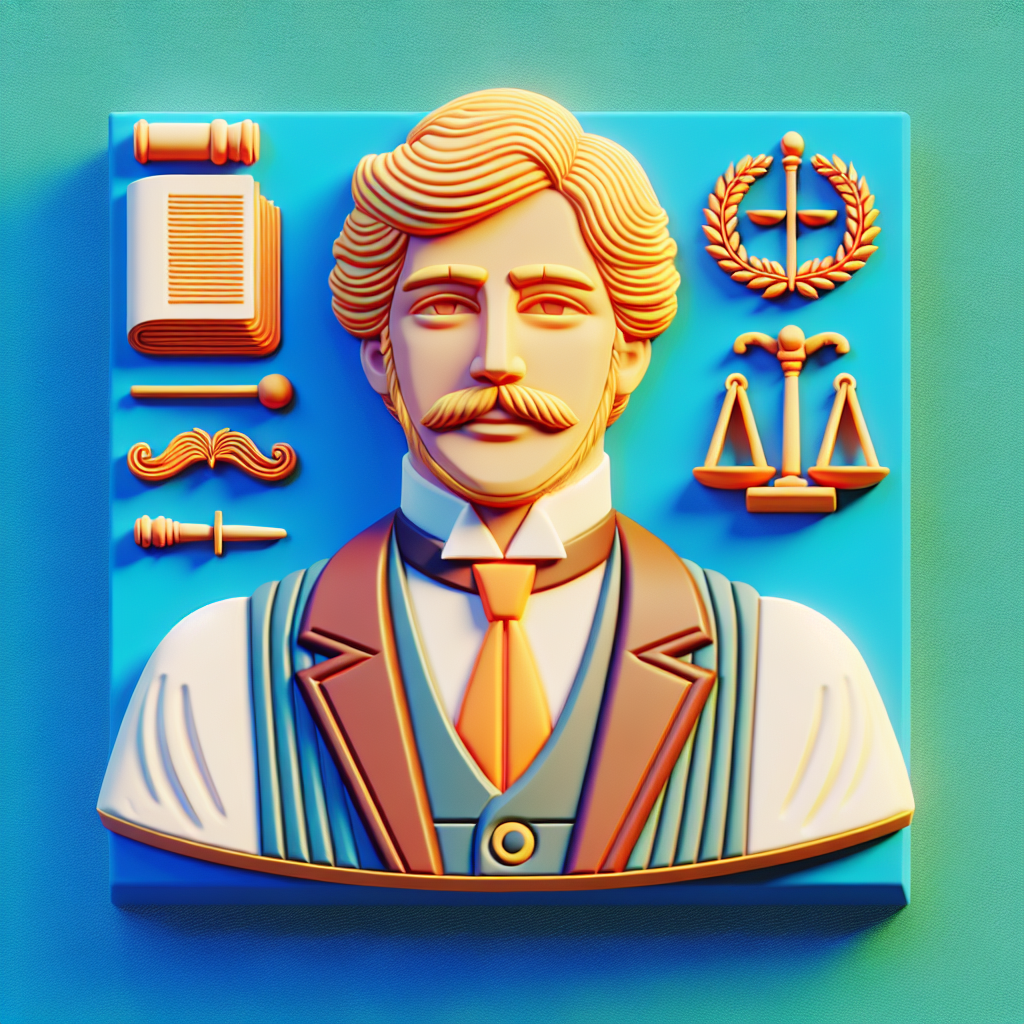

Imagine you're in the 19th-century world of German politics, where change is the only constant, and you're introduced to a man with a vision as expansive as the horizon—Rudolf von Bennigsen. Born on July 10, 1824, in Lüneburg, Lower Saxony, Bennigsen emerged as a pivotal figure who expertly navigated the political landscape during the formative years of Germany’s national unification. With his forward-thinking mindset, he became a leading advocate for liberalism in Germany, leaving an indelible mark on the political and cultural fabric of the nation.
The Early Years and Political Awakening
Rudolf von Bennigsen's early life set the stage for his future endeavors. Raised in a well-established family, Bennigsen was afforded an education at elite institutions, which undoubtedly shaped his intellectual pursuits. As a young lawyer and politician, he was enchanted by the ideas of liberal constitutionalism, which advocated for freedoms we sometimes take for granted today—freedom of speech, a free press, and the rule of law.
By the age of 29, Bennigsen had already stepped into his political stride. He became a member of the Second Hanoverian Chamber in 1856, where his intrinsic optimism and belief in gradual reform distinguished him from more radical contemporaries. Bennigsen had an incredible ability to dissect complex political theories and present them in a way that resonated with the common populace.
Championing German Unification
A pivotal player on the chessboard of 19th-century politics, Bennigsen was one of the most passionate proponents of a unified Germany—a concept which was a patchwork mosaic of small states at the time. The question of German unification was more than a matter of territory; it was a philosophical and spiritual endeavor that required the balancing of myriad interests, ideologies, and economies.
By founding the National Liberal Party in 1867, Bennigsen managed not just to accumulate widespread support but also to mold the party's doctrine as a blend of liberalism and nationalism. His methodical optimism guided the party's journey through turbulent waters, holding fast to the dream of a united Germany under Prussian leadership, while maintaining essential civil liberties.
The Kulturkampf and Dreams of Unity
One of Bennigsen's defining periods came during the Kulturkampf—a series of conflicts between the Prussian state and the Catholic Church during the late 19th century. Bennigsen, ever the pragmatist, saw this cultural struggle as a means to fortify the idea of a secular, unified nation. In collaboration with Otto von Bismarck, he supported legislative initiatives that aimed to curb the influence of the church in public affairs.
Bennigsen's adept negotiation skills were key during these years, facilitating cooperation between the Church, the state, and liberals. This balancing act not only reflected his political prowess but also his optimism about the potential of human society to reach consensus even amidst conflict.
Legacy and Impact
Rudolf von Bennigsen's influence persisted long after his death in 1902. His life is a testament to the power of optimism and thoughtful reform in the face of myriad challenges. By promoting liberal values within a framework of national unity, Bennigsen has left a legacy that underscores the importance of maintaining open, balanced dialogues in political arenas.
What makes Bennigsen's story truly inspiring is not just his list of accomplishments but the manner in which he achieved them. His belief in humanity's potential to work together towards common goals is a sentiment that, even today, offers a beacon of hope to those researching systems of governance.
Understanding Bennigsen in Today's World
Why should we care about Bennigsen now, over a hundred years after his passing? The answer lies in the timeless nature of his optimism and advocacy for humanistic policies. In a world where political polarization is a growing concern, Bennigsen’s life serves as a reminder of the power held by ideas and their ability to ignite transformational change.
Bennigsen was a man who believed in the potential for a better world not through reckless upheaval, but through the harmonious interplay of diverse ideas. His insights into human behavior and society provoke thought and discussion, encouraging us to envision a future built upon similar principles of collaboration and understanding.
Let us remember Bennigsen as the architect who imagined a united German heart, orchestrated through the rhythm of liberal ideals, and as a testament to the endless possibilities that arise when optimism meets action.