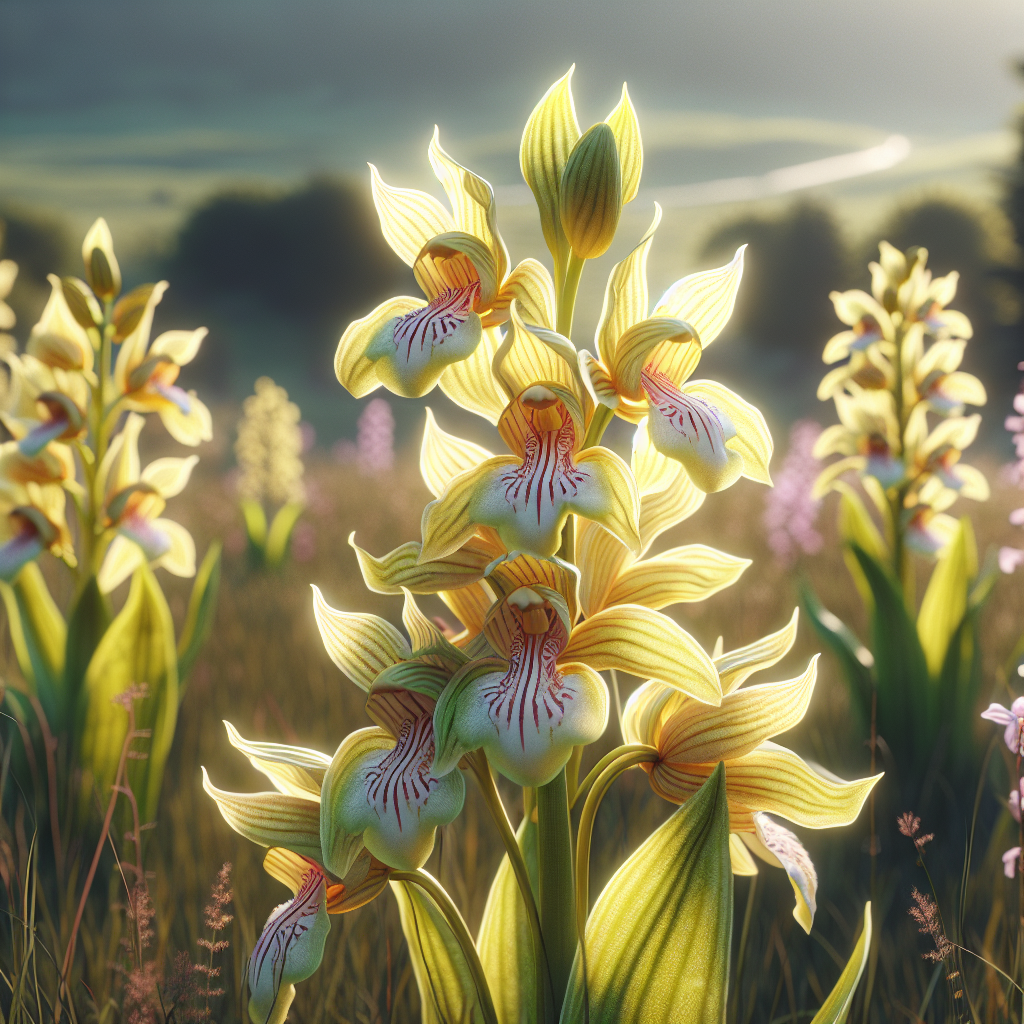

Unveiling Orchis pallens: The Gentle Yellow Beauty of European Woodlands
Imagine stumbling upon a delicate splash of sunshine in the heart of a dim European forest—that’s Orchis pallens for you, a captivating wild orchid that stands as a testament to nature’s whimsical artistry. This charming plant thrives predominantly in the temperate regions of central and southern Europe, and has been tantalizing botanists and nature enthusiasts alike since it was first identified by botanist Carl Linnaeus in the 18th century.
The Spotlight on Orchis pallens
Orchis pallens, also known as the Pale Orchid, belongs to the larger Orchidaceae family—a family that is as fascinating as it is vast, boasting an estimated 28,000 species worldwide. This particular species is known for its subtle beauty, characterized by gentle yellow blossoms that harmoniously blend with the understory greens of its woodland habitat.
Habitat and Distribution
Among the rich tapestry of European woodlands, Orchis pallens makes its home. Its geographical spread stretches from the verdant landscapes of the Pyrenees through to the dense forests of the Western Carpathians, touching the fringes of Southern Europe. This orchid thrives in altitudes ranging from lowland areas to mid-mountain regions, favoring calcareous soils that are typically found in open deciduous forests or at the edges of meadows and clearings.
Understanding Orchis pallens' Life Cycle
Orchid enthusiasts are often captivated by the life cycle of these plants, and Orchis pallens is no exception. Like its orchid kin, this plant grows from underground tubers—an adaptation that allows it to store nutrients and withstand varying environmental conditions. The life cycle typically begins with the sprouting of basal leaves in early spring, which develop into a leafy rosette.
As late spring arrives, a singular inflorescence emerges, adorned with a cluster of small bright yellow flowers. The blooms have an intriguing lip structure known as a labellum, which acts as a landing pad for pollinators. Post-pollination, Orchis pallens produces seeds in elongated capsules, ready to disseminate across the ground, ensuring the continuity of this species in its natural habitat.
The Botanical Features of Orchis pallens
The physical characteristics of Orchis pallens are a botanical spectacle. Its pale-yellow flowers, about a centimeter in length, are arranged loosely around a slender stem that can grow up to 40 centimeters tall. Each flower exhibits a classic orchid structure with three sepals and three petals, one of which forms the labellum.
What’s particularly fascinating is the perfume-like scent these flowers emit, which plays a significant role in attracting pollinators such as bees and butterflies—a delightful symbiosis observed in nature. The leaves, which are typically smooth and lanceolate, envelope the lower part of the stem and serve as the primary photosynthetic structure of the plant.
Conservation Status and Environmental Role
Orchis pallens is regarded as a species of Least Concern by the IUCN, reflecting its relatively stable populations across Europe. However, like many wild plants, it faces threats from habitat disturbance and over-collection. Conservation efforts are crucial to ensure that this wild orchid continues to thrive within its native ecosystems.
In ecological terms, Orchis pallens plays an integral role in its habitat. It contributes to the biodiversity of the woodland undergrowth, providing essential services such as pollinator attraction and maintaining the structural integrity of soil when its tubers anchor to the ground.
Orchis pallens in Human Culture
Unlike some of its orchid relatives, Orchis pallens does not have a significant history in traditional medicine or consumption. However, its aesthetically pleasing nature garners appreciation from gardeners and orchid collectors. Despite its beauty, wild collection is heavily monitored and often discouraged due to conservation laws across Europe.
In recent years, professional horticulturists have developed sustainable cultivation practices, enabling the propagation of Orchis pallens in garden settings without impinging upon wild populations. These cultivation efforts highlight humanity’s ingenuity in conserving natural beauty while appreciating it.
Discovering Orchis pallens: A Journey Worth Taking
Whether you are a seasoned botanist or a curious nature lover, setting out to spot Orchis pallens in its natural habitat is an enlightening experience. Trekking through the woodlands during late spring, you'll be greeted by these orchids in bloom, serving as a gentle reminder of nature’s relentless beauty and complexity.
Engaging with Orchis pallens, and indeed any part of our rich natural world, brings forth a profound appreciation for the planet’s biodiversity. As we learn more about this intriguing orchid, we also learn to protect and cherish the ecosystems it calls home, ensuring its survival for generations to come.
The story of Orchis pallens underscores a vital truth: in protecting our natural heritage, we safeguard the essential ties that bind all life forms in a wondrous web of life.