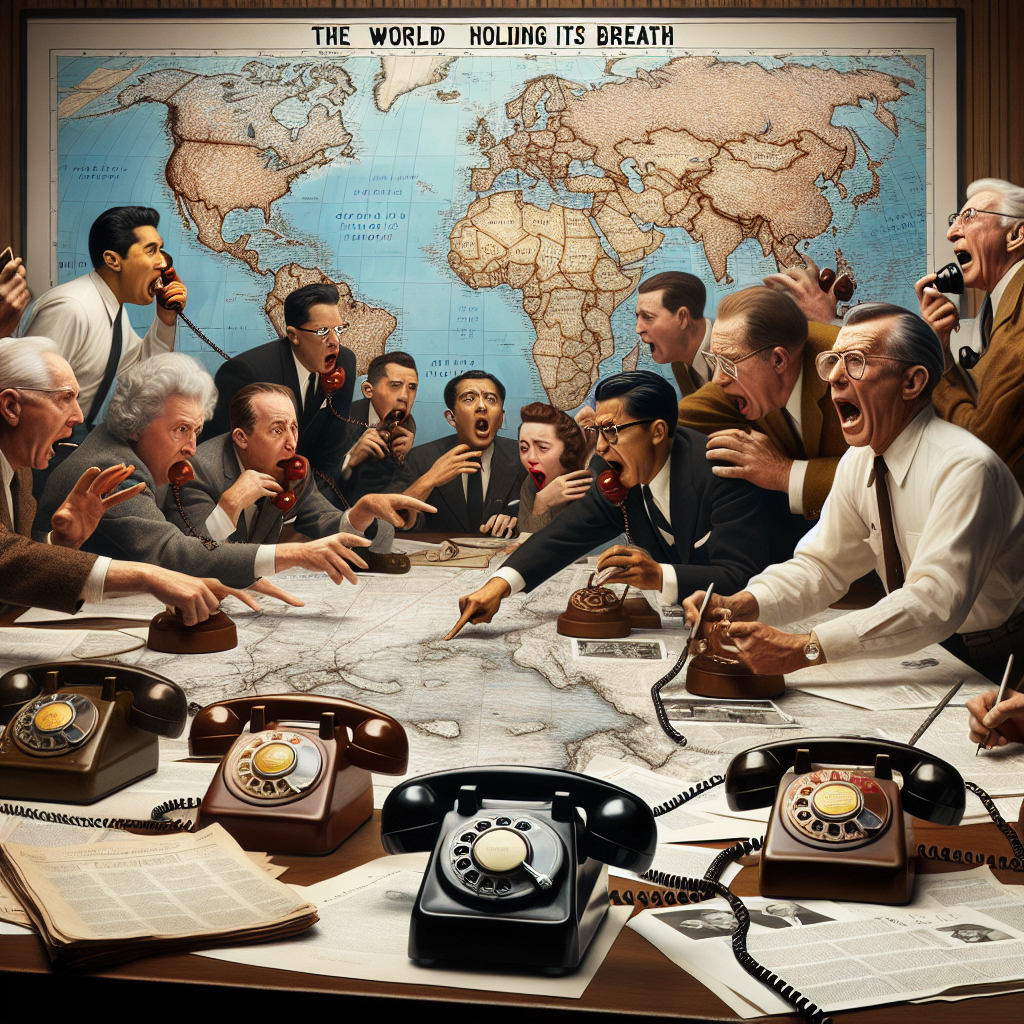

October 1962 was no ordinary month—it was the moment when the world held its breath, standing precariously on the razor-thin edge between peace and nuclear catastrophe. A time of high tension and uncertainty, this was when the notorious Cuban Missile Crisis unfolded, menacingly hanging over humanity. In this gripping episode of history, we see the key players—John F. Kennedy, Nikita Khrushchev, and Fidel Castro—engaged in a high-stakes geopolitical chess match over Cuba, where the deployment of Soviet missiles threatened to escalate into nuclear war. Let's embark on a journey to this fateful month to unravel its complex tapestry and illuminate the extraordinary resilience of communication, diplomacy, and human spirit.
The Tense Prelude
In the opening days of October 1962, the United States, under the presidency of John F. Kennedy, discovered through photographic evidence captured by U-2 spy planes that the Soviet Union, led by Nikita Khrushchev, had installed ballistic missiles in Cuba, just 90 miles off the coast of Florida. These missiles had the potential to reach and obliterate significant portions of the US, dramatically amplifying East-West tensions in the Cold War.
The Soviet Union, seeking to balance the power scales that had recently tilted significantly in favor of the United States, after the failed Bay of Pigs Invasion in 1961, had clandestinely planted its military foothold in Cuba. This strategic maneuver was meant to deter another US invasion of Cuba and, in larger strategic calculus, reduce the US's nuclear threat advantage.
The World Holds Its Breath
Faced with an enormous decision, President Kennedy convened the Executive Committee of the National Security Council, better known as ExComm, to navigate this perilous situation. Over the course of 13 intense days, from October 16 to October 28, the world watched as the superpowers exchanged messages and calibrated moves in a dark dance on the brink of war.
Kennedy initially considered airstrikes and invasion as potential solutions but eventually opted for a middle path: a naval blockade—termed a "quarantine"—around Cuba to prevent further Soviet shipments of military equipment. The term "quarantine" was deliberately chosen over "blockade" to avoid the connotation of war under international law.
The Diplomacy of Caution
The tension escalated day by day. On October 22, Kennedy addressed the nation and the world in a televised speech, revealing the presence of missiles in Cuba and announcing the quarantine. He emphasized the US's determination to remove this existential peril and stated that any missile launch from Cuba would be considered an act of war requiring full retaliatory actions against the Soviet Union.
Negotiations were teetering on a knife's edge. Messages flew between Washington and Moscow, showcasing a behind-the-scenes drama filled with strategic maneuvering and heartrending decisions. Khrushchev, though initially defiant, was well aware of the catastrophic implications of a nuclear exchange. His communication to Kennedy was increasingly leaning towards diplomacy, hinting his willingness to dismantle the missile sites provided the US pledged not to invade Cuba, along with the eventual removal of US missiles from Turkey.
The Climax of Diplomacy
As the days dragged on, the mood in ExComm chambers was a tense blend of optimism and fear. The situation came perilously close to escalation multiple times, notably on October 27, which is distressingly termed "Black Saturday." On this day, a US U-2 spy plane was shot down over Cuba and another accidentally entered Soviet airspace, prompting massive fear within the Kennedy administration. Despite mounting pressures, diplomatic channels held strong, with both superpowers acutely aware of the mutual destruction at stake.
Ultimately, Khrushchev agreed to remove the missiles from Cuba in exchange for the US's public assurance not to invade Cuba. A more discreet agreement followed, including the removal of US missiles from Turkey, a decision that Kennedy had decided upon but chose to keep confidential to ease political pressures.
An Eloquent Testimony to Diplomacy
The Cuban Missile Crisis stands as a seminal event in history, perfectly encapsulating the perilous dynamics of the Cold War era. October 1962, through its intense negotiations and near-catastrophes, serves as an eternal reminder of the dangerous and delicate dance of diplomacy. It highlighted not just the brittleness of geopolitical relationships but also the profound strength of measured dialogue.
This extraordinary month taught the world about the necessity of clear communication and the willingness to understand and empathize even with adversaries for the sake of humanity's future. The calm proliferation of cooler heads prevailed over the hawkish calls for war, leaving behind a world that chose wisdom over weapons.
There is something optimistically invigorating about October 1962—it taught us that even at the brink of disaster, when pointed with destructive capabilities, humans possess the ability to step back, to communicate, and to choose a path that is life-affirming rather than life-ending. It is this tireless potential for growth and learning that resonates through history, reminding us, most fittingly, in scientific terms, that the power to avoid mutual destruction often lies in the nuclear fusion of mutual respect.