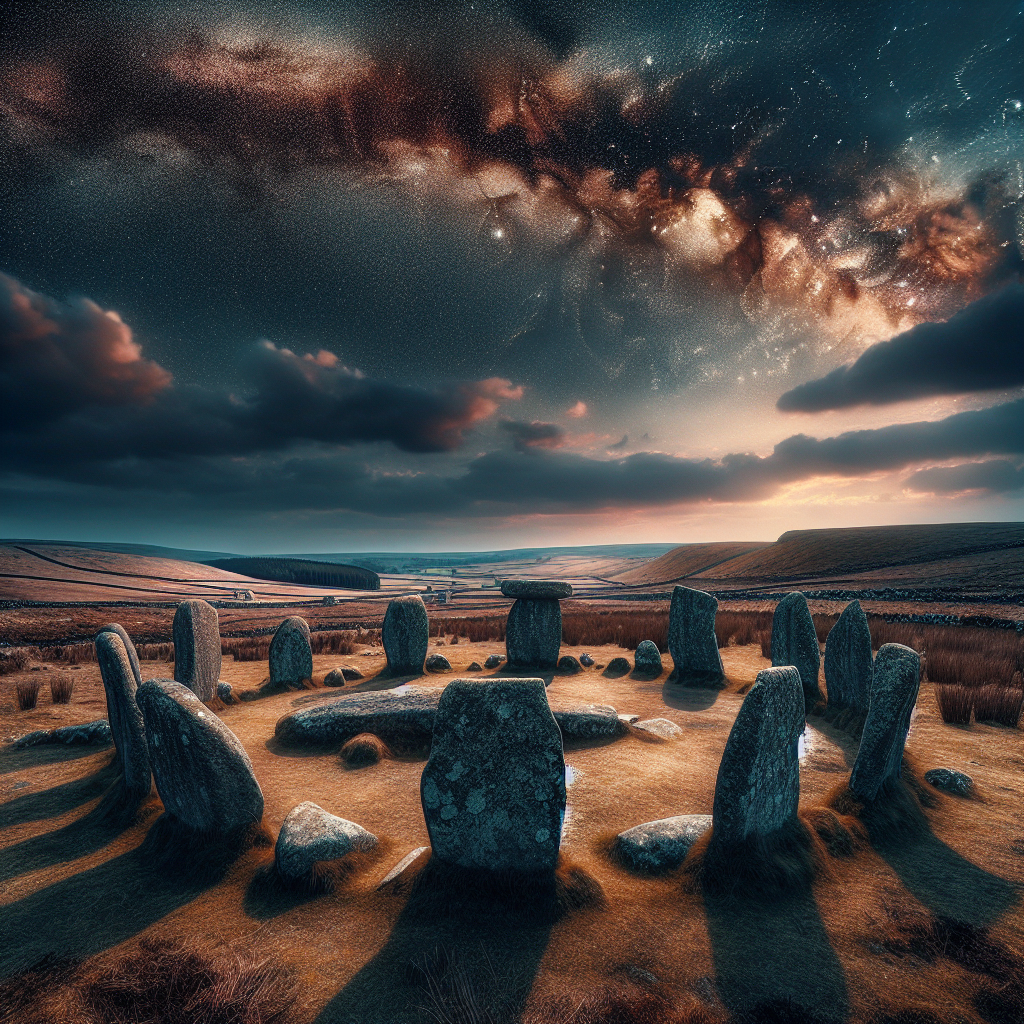

Unearthing Mysteries: The Enigmatic Craddock Moor Stone Circle
Imagine stepping back in time to a world filled with rituals, astronomical events, and ancient communities—an invigorating thought, isn't it? At the heart of Cornwall, England, lies the Craddock Moor Stone Circle, a mesmerizing archaeological site that captures the imagination of scientists and history enthusiasts alike. This awe-inspiring structure, whose roots can be traced back to the Bronze Age (approximately 2500 to 800 BC), is situated on Craddock Moor, near the village of Minions. Its purpose is shrouded in mystery, but its significance transcends time, offering us clues about our ancestors’ lives and their interaction with their environment.
The Story of Stones: What and Why?
The Craddock Moor Stone Circle is a testament to the ingenuity and culture of ancient peoples. Comprising 16 fallen stones arranged in a slightly elliptical formation, with diameters reaching up to 32 meters, this circle is one of many found on the Bodmin Moor. Researchers and enthusiasts have been captivated by its possible uses—from a ceremonial space, a calendrical marker, or even a community gathering site.
But why did ancient communities invest so much labor in erecting these stone circles? While definitive answers remain elusive, scholars suggest that these structures were deeply connected to the social and spiritual life of the people who constructed them. They might have been used for ceremonies that marked astronomical events, thus acting as a collaborative endeavor that bonded societies.
Science Meets Mysticism: Decoding the Circle
What’s absolutely fascinating about stone circles like Craddock Moor is the merging of science and mysticism. By studying the layout and orientation of stones, archaeologists have long suspected these structures had astronomical significance. The careful alignment with celestial bodies demonstrates a sophisticated understanding of the natural world.
Through methods such as archaeoastronomy, researchers examine alignments focusing on solar and lunar events. Although not all experts agree on their exact purpose, it's compelling to consider how these markers might have served as an ancient farmers' almanac for tracking seasons and celestial occurrences. Scientific exploration thus opens avenues into how Bronze Age communities observed and utilized the cosmos.
Innovation in Research: Modern Tools of Discovery
The thrill of discovery combines historical interest with cutting-edge technology. Scientists today utilize advanced surveying techniques like LiDAR (Light Detection and Ranging) to create high-resolution images of the landscape, including areas overgrown by vegetation. Thanks to LiDAR, archaeologists can uncover hidden features and forms that have evaded detection by traditional methods.
Radiocarbon dating of organic materials found in the vicinity and petrography—examining stone composition—provides more accuracy in dating and sourcing the stones. These modern tools unearthed valuable insights about the stone circles’ origins and evolution over millennia.
The Human Element: Our Ancestors’ Legacy
What were the thoughts, beliefs, and aspirations of the people who constructed these magnificent structures? Such archaeological sites serve as a bridge to our past, narrating a story of human curiosity and achievement. The enduring art of stone circles like Craddock Moor breaks through the historical silence, inviting us to kick-start our own quest for understanding, appreciation, and preservation of cultural heritage.
Moreover, these places stand as reminders of human collaboration, the sharing of knowledge and resources to achieve common goals. It invites us to reflect on community, spirituality, and a sense of belonging—a call for unity that echoes through time.
Inspiring Awe: Visiting Craddock Moor Today
Today, visiting Craddock Moor immerses one in the untamed beauty of Cornwall’s rugged moorland. The natural landscape offers a gripping backdrop, echoing with the whispers of history. As you walk among the stones, feel connected to the past and the countless generations that gazed at the same skies. Remain respectful and mindful of preserving this ancient heritage—we owe it to the spirit of inquiry and discovery.
The Craddock Moor Stone Circle isn't just a structure of stones; it's a living piece of history, a testament to the experiences, beliefs, and advancements of our ancestors. As we continue to uncover the secrets locked within these stones, every discovery extends our understanding of human history. With an optimistic perspective, we embrace this extraordinary connection to our past—a remarkable journey through time that inspires endless fascination.