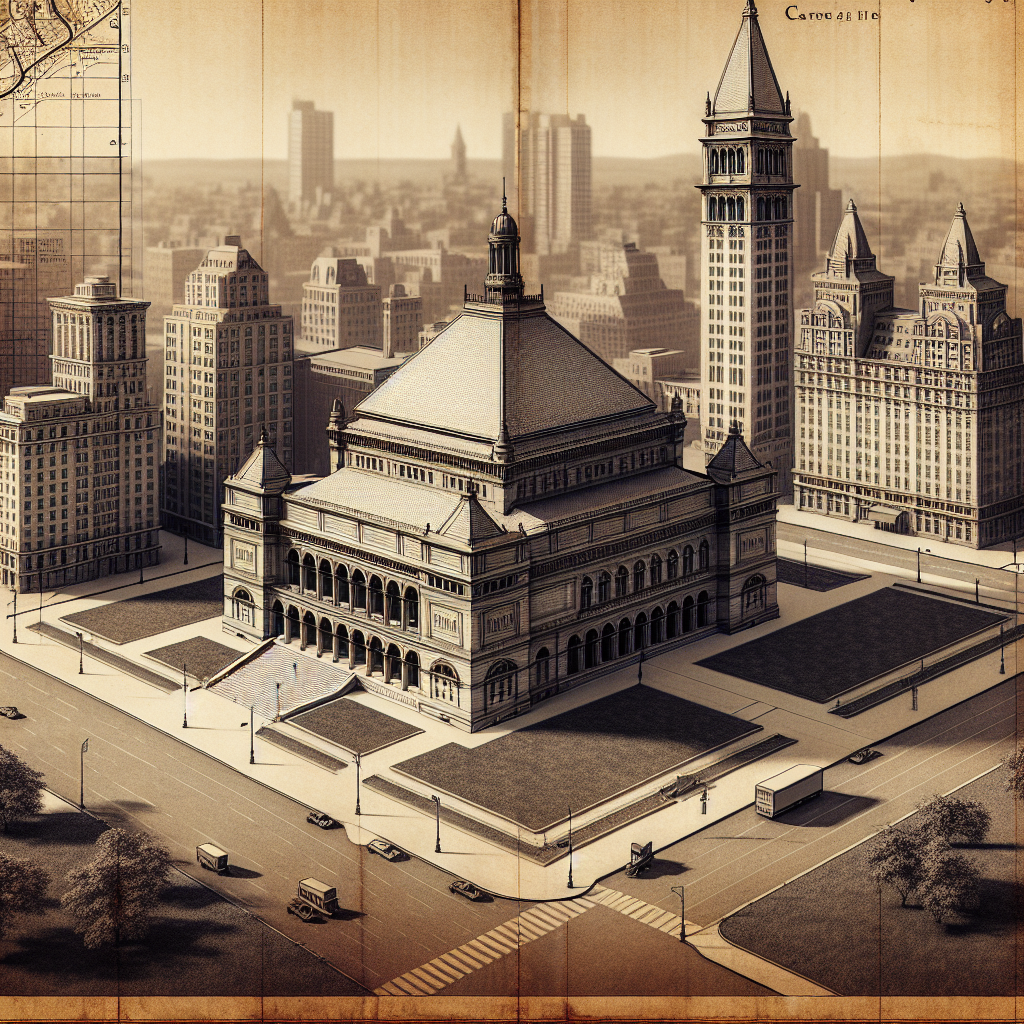

Imagine a stage where legendary voices still echo, a place where the magic of human creativity hums in every corner. Welcome to Carnegie Hall, a hub of cultural convergence and historical significance nestled amidst the bustling streets of New York City. Founded by Andrew Carnegie in 1891, this iconic concert hall has been the epicenter for some of the most memorable performances, hosting maestros, legends, and rising stars across its storied past. With its stunning acoustics and rich history, Carnegie Hall stands not just as a venue but as a symbol of humanity's endless pursuit of artistic excellence and connection through sound.
The Origins of a Cultural Juggernaut
Arriving in New York City at the brink of the 20th century was an establishment destined to reshape the landscape of music performance: Carnegie Hall. Funded and built by the philanthropist and steel magnate Andrew Carnegie, construction began in 1889, culminating in a grand opening in 1891. At that time, New York was a burgeoning metropolis, yearning for a world-class concert venue, and Carnegie's vision filled that void splendidly.
Remarkably, the Hall's inception was driven by something more than bricks and mortar—it was born from a love for music and a conviction that arts should be accessible to all. Carnegie was known for his belief in the power of music to elevate society, and his eponymous Hall was his gift not just to New York, but to the world.
Architectural Marvel and Acoustical Paradise
So, what makes Carnegie Hall such an incredible place to watch a performance? It goes beyond just fancy bricks and mortar. It’s a remarkable blend of architectural ingenuity and acoustic mastery. Designed by architect William Tuthill, who, interestingly enough, was a largely self-taught acoustician, the Hall is both a visual and auditory masterpiece.
The Hall comprises three distinct auditoriums: the Main Hall (Stern Auditorium/Perelman Stage), the more intimate Zankel Hall, and the Weill Recital Hall. Each space is specially designed to create an ethereal sound experience, making it a bucket-list venue for performers and listeners alike.
Special care was taken during its construction, employing ingenious designs that allowed sound to resonate with breathtaking clarity. The scientific magic lies in its seamless blending of hard and soft surfaces, making sound dance within its walls in ways that still impress acousticians today.
Home to Legends and Innovations
Carnegie Hall's historical footprint is marked by performances that have shaped the music world. Who hasn’t heard of legendary figures like Leonard Bernstein, who made his conducting debut here in 1943, or the great Ella Fitzgerald and her soulful renditions? The Beatles even played to a mesmerized crowd in 1964, adding to the Hall's illustrious mythos.
But the Hall isn't just a museum for past triumphs. Carnegie remains a dynamic forum for contemporary superstars and rising talents. It is also a crucible for innovation, hosting technological and artistic innovations that push the limits of live performance.
A Fusion of Science and Art
For those enchanted by numbers and formulas, it’s fascinating to note that every note struck on that stage is an amalgamation of artistry and physics. The materials and shapes used cleverly distribute sound waves, optimizing every performance from a full orchestra to a single voice.
It serves as a reminder of how intertwined science and art truly are, how the rhythm of one is often an arithmetic of the other, and how both can invoke the purest form of human emotion.
The Continuing Legacy
While Andrew Carnegie’s steel once built the railroads and skyscrapers of America, his generosity built a legacy where human expression reigns sovereign. Carnegie Hall not only serves as a magnificent venue for performances but also as a catalyst for arts education. Through programs like the Weil Music Institute, the Hall reaches beyond its own walls, introducing thousands of students to the joy of music.
Moreover, the Hall's digital and community outreach efforts have expanded its influence even further, allowing it to touch hearts globally as well as locally.
Why Carnegie Hall Persists as an Icon
One might ask, why has Carnegie Hall remained so revered across the decades? This venue stands as a living testament to the transformational power of art. It embodies a tradition of excellence where every performance becomes part of a grand narrative, knit together by shared human experiences.
It isn't just a building. It’s a living, breathing cultural phenomenon that encourages learning, fosters unbridled creativity, and, most importantly, unites people of various backgrounds through the universal language of music.
In this ever-evolving era, where cultural experiences are increasingly digitized, places like Carnegie Hall give humanity a space to reconnect with the raw, unfiltered splendor of live performance. It nurtures dreams, celebrates diversity, and inspires generation after generation.
So, whether you're a seasoned musician hoping to grace its stage, or someone experiencing a symphony for the very first time, Carnegie Hall remains an exciting testament to everything vibrant and enduring about human creativity.