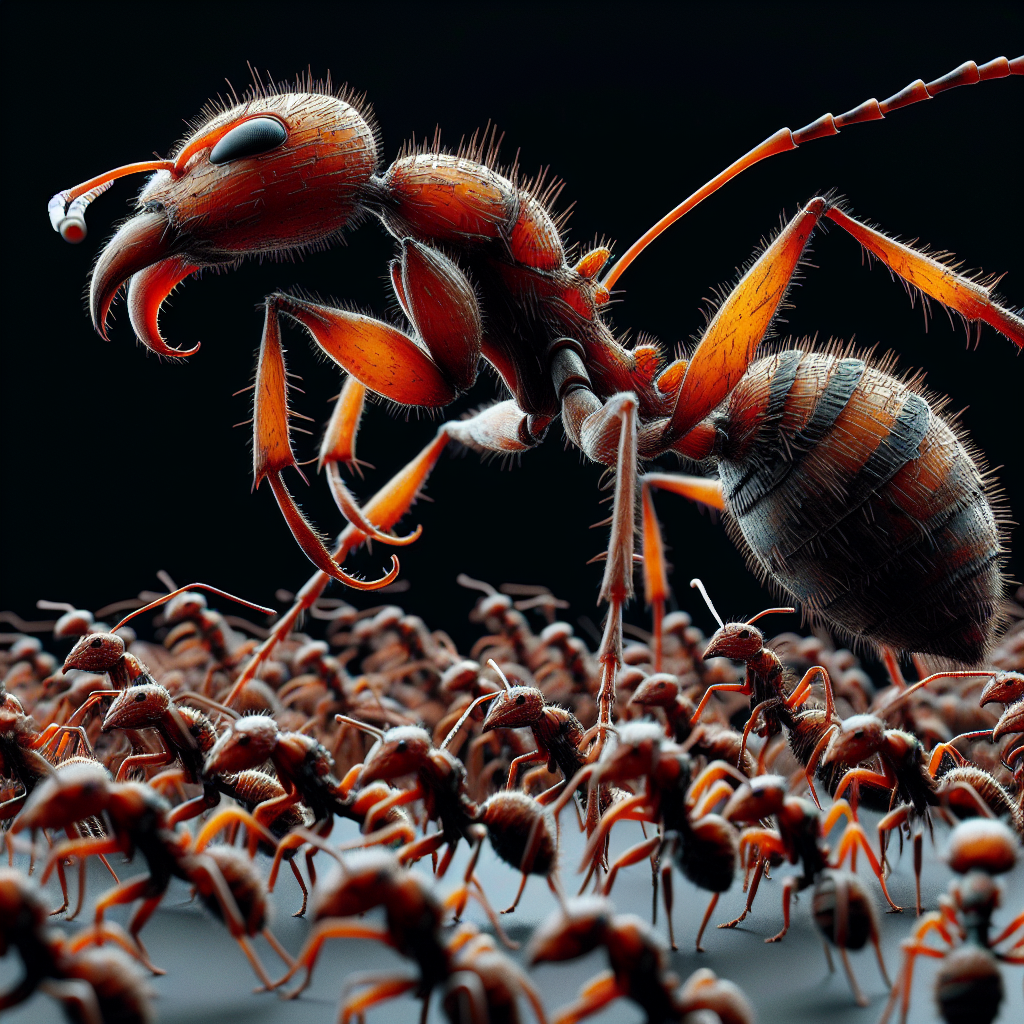

The Marvelous March of the Army Ants
Imagine a bustling city on the move, where every citizen has a role, and the entire metropolis is constantly shifting location. This is the world of the army ants, a fascinating group of ants known for their nomadic lifestyle and complex social structure. Found primarily in the tropical and subtropical regions of Central and South America, Africa, and Asia, these ants are a marvel of nature's engineering. Army ants, belonging to the subfamily Dorylinae, are known for their aggressive foraging behavior and massive colonies that can consist of up to a million individuals.
Army ants are unique because they do not build permanent nests. Instead, they form temporary bivouacs, which are living nests made up of the ants themselves. These bivouacs are created by the ants linking their bodies together, providing shelter and protection for the queen and her brood. The colony is constantly on the move, migrating to new locations in search of food. This nomadic lifestyle is driven by their need to find sufficient prey to sustain their large numbers.
The foraging behavior of army ants is a sight to behold. They move in large swarms, known as raids, that can cover several hundred meters in a single day. These raids are highly organized, with worker ants forming columns that fan out to capture prey. The ants are blind, relying on chemical signals called pheromones to communicate and coordinate their movements. This allows them to efficiently hunt and capture a wide variety of prey, including insects, spiders, and even small vertebrates.
The army ant's role in the ecosystem is significant. As predators, they help control the populations of other insects and arthropods, maintaining a balance in their environment. Their raids can also influence the behavior and distribution of other animals, as many species have adapted to follow the ants and feed on the insects that flee from the advancing swarm.
The study of army ants provides valuable insights into the evolution of social behavior and cooperation. Their complex social structure and division of labor are key areas of interest for scientists seeking to understand how such systems evolve and function. The army ant's ability to work together as a cohesive unit, despite their blindness, is a testament to the power of communication and cooperation in the natural world.
In summary, army ants are a remarkable example of nature's ingenuity. Their nomadic lifestyle, complex social structure, and role in the ecosystem make them a fascinating subject of study. As we continue to learn more about these incredible creatures, we gain a deeper appreciation for the intricate web of life that surrounds us.