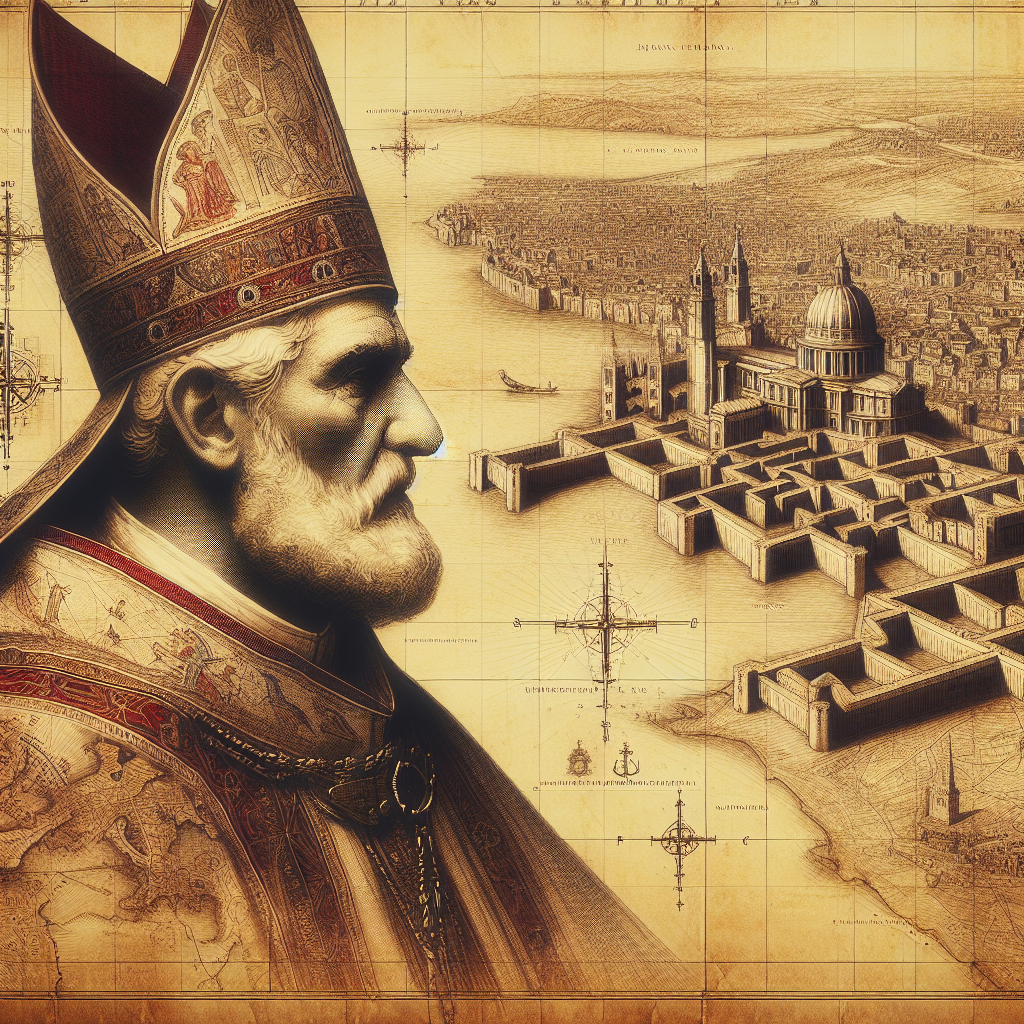

Amidst the spirited chaos of 13th century England, a name echoed through the halls of power—Walter de Gray. As a prominent ecclesiastical figure, his wits and political savvy were what some might compare to the grace of a medieval ballerina. Walter de Gray was the Archbishop of York from 1215 to 1255, a role he took over after the tumultuous days surrounding the signing of the Magna Carta in England, charting a course through a landscape rife with political intrigue and religious transformation.
Born around 1185 in the eons before the digital age in Northumberland, Walter de Gray quickly rose through the ranks of the church, eventually finding himself in a significant yet precarious position of influence among the English monarchy and the church establishment. He was a man who understood the dramatic shifts and fragile allegiances that characterized King John's reign, culminating in his unique contribution to maintaining a semblance of stability during his tenure as one of the longest-serving Archbishops of York.
But what made de Gray stand out wasn't just his dedication to the church, but his knack for diplomacy that bridged the chasm between the secular and the sacred. At a time when the lines between monarchy and religion were as blurry as the deadline you forgot, de Gray served as a pivotal mediator, navigating the difficult terrain patiently even as storms of betrayal and rebellion brewed around him. His appointment to several administrative roles, including Lord Chancellor of England, speaks volumes about his skills of mediation and statesmanship.
Walter de Gray's political maneuvering also places him as a revered yet controversial character in the sweeping narratives of history. Despite the seismic shifts in politics, he managed to secure a lengthy tenure in office, something that spoke of his capability to both charm and challenge power. To his admirers, he was a beacon of peace and progress; to his detractors, he was crafty—perhaps too much so. Such dichotomies are perhaps not uncommon for leaders who last several decades in roles as contentious as his.
Gray's most visible legacy perhaps lies in the architecture of York Minster itself, an emblem of his commitment to the city and the church. He began the work on the current York Minster cathedral, undertaking ambitious extensions including the south transept, which began under his vision and served as a future testament to the wealth and power of the ecclesiastical architecture during that era. It's as if his grand architectural aspirations were an attempt to harmonize and amplify the grandeur of the divine for generations to witness and gasp at.
Some people say he was just an ambitious churchman, but maybe he was simply playing a game of historical chess, where every move was calculated to protect his King, which, in this case, were the multiple facets of the English church. It's convincing that Walter de Gray, in part, engineered an era of relative stability through his alliances, gaining respect, even if grudgingly, from different quarters. His long tenure is a sign of how he managed to ride out turbulent times that would have felled a leader of lesser mettle.
It wasn't all a walk through medieval gardens, though. His career wasn't devoid of controversy, especially with regards to his acquisition of wealth and lands, indicative of the powerful roles played by church officials at the time. It's said that with great power comes great responsibility, but it seems that every superhero's cape can also shield controversies. Such stories add layers to our understanding of de Gray, inviting us to question: does one judge solely on intention, or impact?
Nonetheless, Walter de Gray's storied existence was one that danced between the lines of influence and resilience, shaping not just York and its minster but also his good share of spiritual and temporal policy. Today, for a generation that often sees itself as a catalyst for change, grappling with its own conflicts of authority and tradition, looking back at figures like de Gray offers a stark reminder—sometimes to play the game, you must understand both the chessboard and the pieces even if it means making moves that are unpopular at first.
His life, as part of England's past where church and state were tightly interwoven, teaches us more than just historical fact—it adds a human flair to what often is reduced to dry monarchical and religious statistics. Real change is often enacted by humans who dared to balance on that edge where ambition planes into vision.
Walter de Gray's footprint lives on, not just in the stone and temporal thematic sketches of York Minster, but also in the resilient thread that weaves politics and faith. His legacy shows that while sometimes routine decisions might lead to controversy, it's the overall narrative that these choices form which ultimately craft the hues of history.