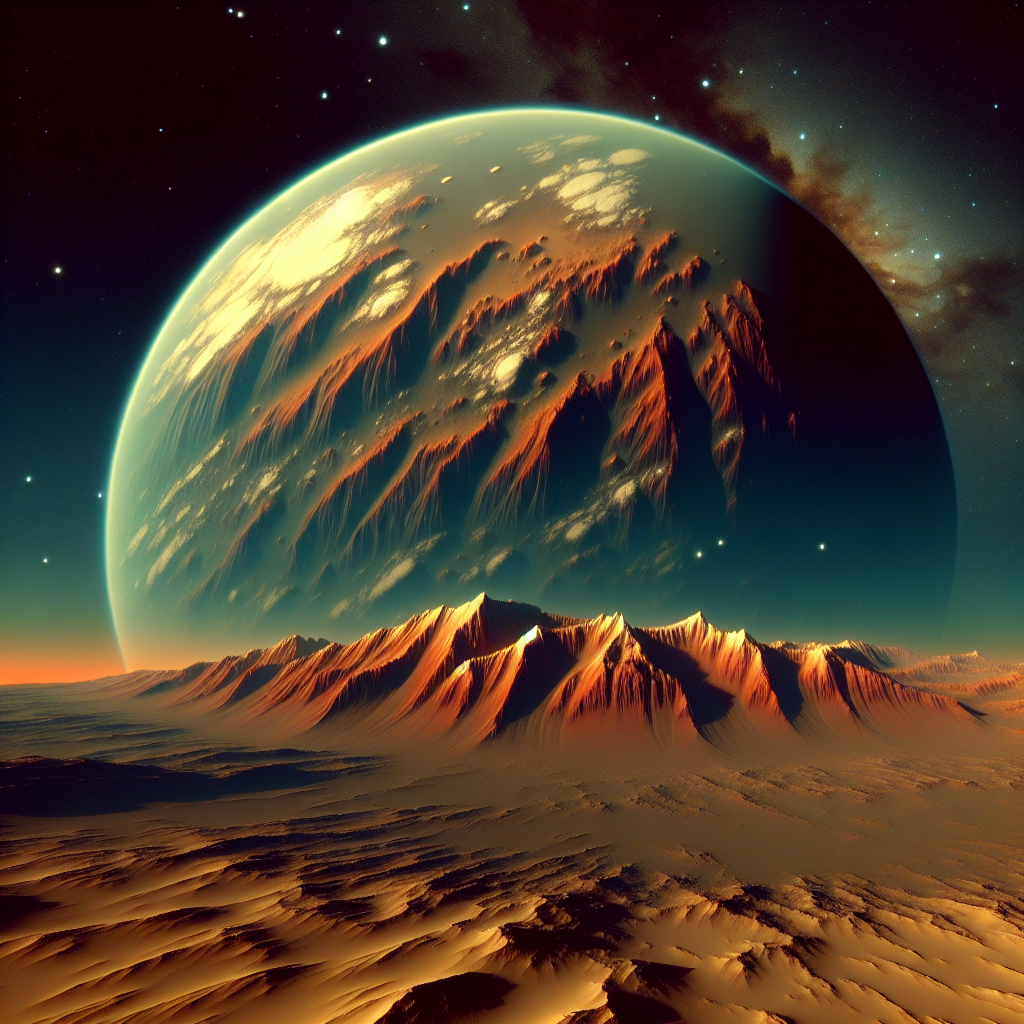

Picture this: a giant eye staring back at you from the surface of Mars. That's essentially what Solis Lacus is, often called the 'Eye of Mars,' a fascinating region known for its distinctive dark spot. This eye-catching feature is located near the Martian equator and has intrigued scientists and space enthusiasts alike since it was first observed by astronomers in the 19th century. Solis Lacus, Latin for 'the Lake of the Sun,' has captured imaginations and inspired questions about its origins, the secrets it may hold, and its ever-changing appearances over time.
The 'Eye of Mars' evokes a sense of curiosity, sparking debates and theories that range from scientific to speculative. Scientists see it primarily as an area marked by dark materials, probably resulting from wind-blown dust or volcanic activity. This region, when observed from telescopes, undergoes seasonal changes, as if the planet is morphing right before our eyes. These changes have led many to ponder what dynamic processes are taking place on the Martian surface.
Mars enthusiasts and professional scientists have both marveled at the possibility of ancient water flows or even current geological activity in this region. The changing appearance of Solis Lacus could be a remnant of a bygone era when Mars might have had conditions suitable for life. Others have speculated that beneath its intriguing surface, Mars might be hiding much more than just geological mysteries.
As the fourth planet from the Sun, Mars has always been shrouded in a veil of mystery. Solis Lacus adds to this intrigue, amplifying questions about whether it might one day reveal secrets that could reshape our understanding of the Red Planet. The 'Eye of Mars' doesn't just reflect sunlight, it reflects humanity's age-old curiosity about life beyond our own planet.
Notably, this dark feature has been a critical area of interest for missions desiring to unlock the Martian secrets. The dynamic nature of Solis Lacus has been monitored through missions like Mars Global Surveyor and orbiters capturing its shifting appearance. Each image and data set collected adds crumbs to the trail leading to the mysteries of Mars' past and its climatic evolution.
While some see a barren wasteland in Mars, others, particularly within the scientific community, see a canvas filled with potential discoveries. Various theories suggest that Mars was once a wetter planet, possibly housing conditions that could have supported life forms. Solis Lacus stands as a silent witness to these massive transitions over time. Could its dark materials be lava beds or ancient ocean floors, proclaiming tales of ancient Mars?
Looking at Solis Lacus through telescopes, one can't help but notice how its bright halo-like appearance contrasts with the dusty plains of Mars. This contrast has prompted hypotheses about vast wind-swept plains or the presence of different minerals. For researchers, spotting and deciphering these contrasts are crucial for unlocking Mars' climatic puzzle.
For those opposing interplanetary exploration, mainly due to financial constraints or environmental concerns, the question often arises: why focus on Mars at all? Many argue that these missions consume resources that could better serve Earth-bound challenges. On the other hand, supporters highlight that understanding Martian mysteries like Solis Lacus could inform us about Earth's own climate history and future.
The dialogue between these two perspectives enriches the discourse around space exploration. The debate extends beyond just money and politics, touching on philosophical questions about humanity's role in the universe. Are we just Earth-bound observers, or explorers at heart, destined to unravel the universe's offerings?
For Gen Z, a generation often characterized by its digital fluency and environmental consciousness, the prospects of Mars exploration represent a paradoxical blend of cutting-edge technology and ecological sentiment. Curious minds are drawn to the possibility of finding life on Mars, while simultaneously wary of the notion of damaging another planet as we've done to our own.
As scientists continue to peel back the layers of Mars' surface, the revelations from regions like Solis Lacus may not immediately answer all our questions but will undoubtedly stimulate further exploration and creative thinking. It is in these mysteries that we find both the allure and challenge of space exploration.
The dark spot on Mars thus remains a beacon, representing more than just a scientific interest. It is a space for imagination, a trigger for debate, and a question mark hanging over the Martian sky. Until we uncover more, Solis Lacus will continue to invite both inquiry and awe.