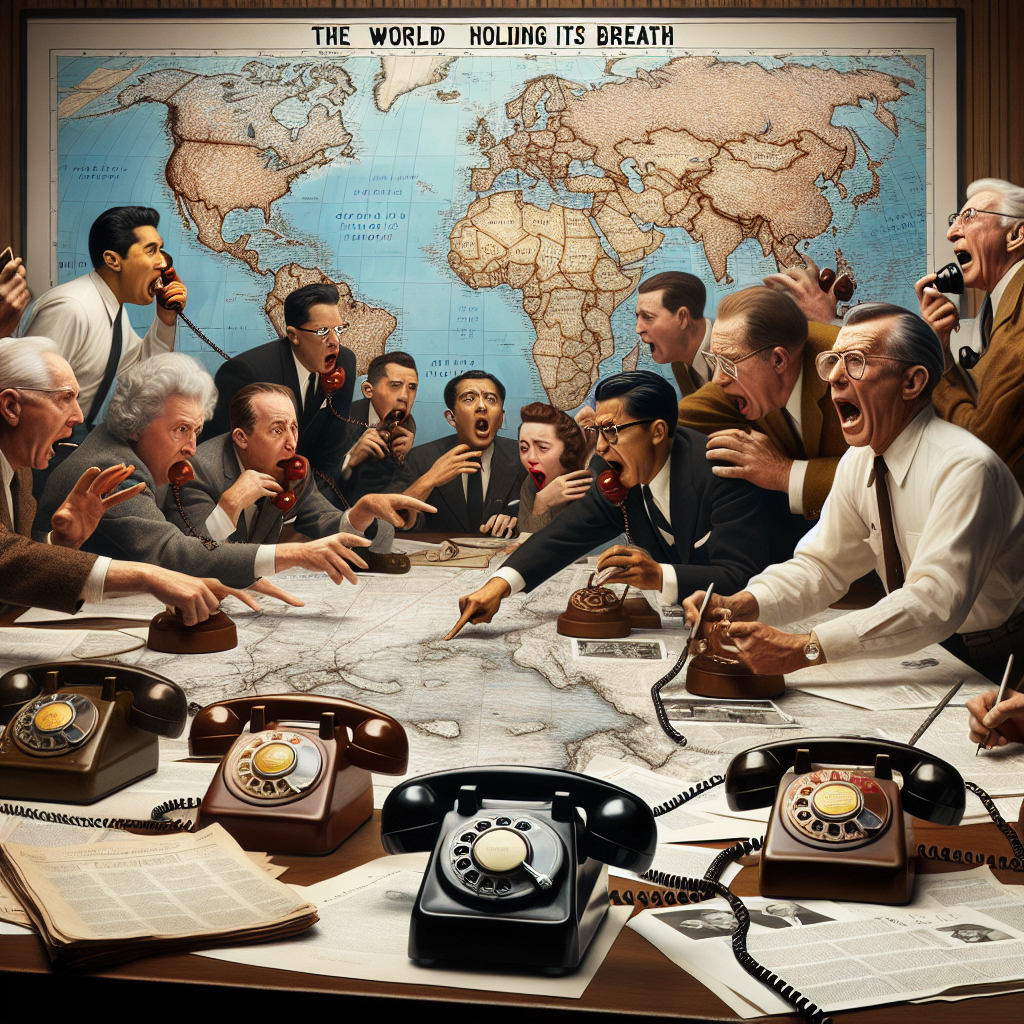

If ever there was a month that could send shivers down your spine, it would be October 1962. During this spine-tingling month, the world teetered on the brink of nuclear disaster as the Cuban Missile Crisis unfolded. This was a showdown between the United States and the Soviet Union, superpowers locked in a Cold War chess match over nuclear missiles stationed just 90 miles from the U.S. coast, in Cuba. It wasn’t just about missiles; it was about power, politics, and ideologies colliding head-on. This moment brought fear into the living rooms of average folks, with President Kennedy and Soviet Premier Khrushchev playing a high-stakes game that could have changed the world forever.
The Cuban Missile Crisis began when American reconnaissance photographs revealed Soviet missiles in Cuba. Imagine being told that these weapons, capable of reaching the U.S. mainland within minutes, were sitting under the tropical Cuban palms. Everyone from politicians to school children was gripped by a tangible tension, straddling hope and hysteria. This wasn’t just the plot of some Hollywood thriller; this was reality.
President Kennedy had to act quickly but carefully. The world watched as he delivered an ultimatum on live television on October 22nd, demanding the removal of the Soviet missiles. He announced a naval blockade around Cuba, determining that the long shadow of nuclear war wouldn’t fall without a fight. Yet, some critics wondered if this tough stance was pushing the envelope too far. What if a cornered Soviet Union struck back, leading to mutual destruction? The tension was palpable, with everyone on edge.
On the flip side, Premier Khrushchev faced his issues. The Soviet leader wanted to protect Cuba from U.S. invasion while asserting Soviet strength on the global stage. There were those who criticized him for escalating tensions, yet others saw him playing a strategic game to level the military balance, deterring potential U.S. dominance. What might seem like a reckless gamble by Khrushchev was tempered by a quest to show that the Soviet Union wasn’t a second-rate power.
For thirteen nerve-wracking days, the world held its breath. Residents in America ran drills, imagining ducking and covering from nuclear fallout. Those fears were mixed with vibrant protests for peace, where songs and chants echoed the demand for dialogue. As leaders deliberated, a generation of young people were galvanized, questioning the wisdom of those in power and seeking peace over conflict.
The eventual resolution, thankfully, averted catastrophe. Secret back-door negotiations led to a deal on October 28th: the Soviet Union would dismantle its missiles in Cuba in exchange for a U.S. pledge not to invade Cuba and the quiet removal of U.S. missiles from Turkey. Some might see this compromise as a win for diplomacy, showcasing the strength in dialogue over displays of raw power. Yet, others lamented the brinkmanship that had brought the world so close to destruction.
The October crisis has a long afterlife, molding foreign policy thought and nuclear policy for decades. It stands as a testament to both the peril of geopolitical rivalry and the possibility of peace through negotiation. Those lessons still hold water today, as nations continue wrestling with nuclear threats and balancing power dynamics.
Many young people today might wonder how we came so near to disaster and marvel at the decisions of their forebearers. These reflections are not just historical facts: they are teachable moments in an age loaded with new tensions and technological threats. While then, typewritten letters exchanged across continents carried the weight of urgency, today’s equivalents might involve instantaneous digital communiques.
Considering politically liberal views and the pacifism that matured from these historical events, we must appreciate that opposing ideologies need space for empathy and compromise. We have opportunities today, as did those in 1962, to build bridges over ideological chasms.
The shudders of October 1962 might inspire a generational call for understanding. It's about leveraging history to imagine futures that set aside hostility. With the pulse of the past pounding through our veins, Gen Z could take this not as a relic but as a guide for new-age advocacy, hats off to history’s savviest and bravest.