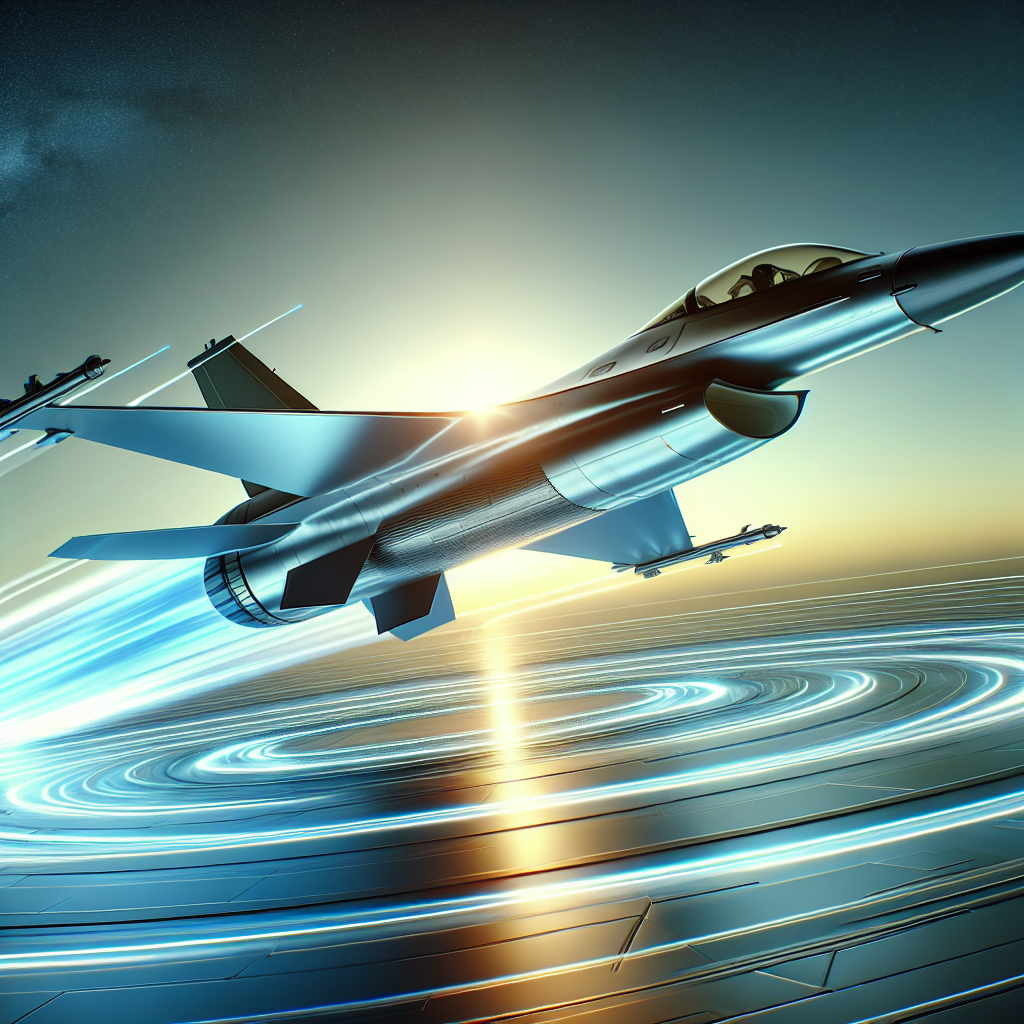

Imagine a jet that was designed with the ambition to fly into the future but never got fully airborne. The General Dynamics F-16XL was this innovative creation, a prototype aircraft developed in the late 1970s and early 1980s by General Dynamics, a company famed for its contributions to aerospace and defense. The F-16XL is an experimental fighter jet derived from the widely successful F-16 Fighting Falcon. It boasted a unique 'cranked-arrow' delta wing, promising enhanced speed, range, and payload capabilities. Its development took place primarily in Edwards Air Force Base, California, a hotbed for testing cutting-edge aviation technology. Despite its potential to redefine air combat, the F-16XL remained a fascinating "what if," shelved after failing to secure a front-line role amid shifting military priorities and budget constraints.
The F-16XL was born in a creative quest to enhance the F-16's already impressive abilities. General Dynamics aimed to transform the aircraft into a multirole fighter-bomber, capitalizing on its advanced aerodynamics. With its elongated wing design, the F-16XL could carry twice the ordnance of its predecessor, an essential quality for missions requiring versatile loadouts. Imagine doubling the ammunition and still outmaneuvering adversaries with ease. This jet was poised to offer increased range without the trade-offs of heavier fuel loads.
But why didn't this flying marvel ever become a staple of the skies? Context is essential here. In the early '80s, the United States military was deeply invested in an array of projects, each vying for a slice of the funding pie. The F-16XL's principal competition was the McDonnell Douglas F-15E Strike Eagle. When it came time for the Enhanced Tactical Fighter competition, the Air Force picked the F-15E, citing its twin engines and larger payload capacity as vital for future conflicts. This decision was not purely technical. The political landscape favored the F-15E's lineage, already a stalwart in the Air Force ranks. The F-16XL, being more of a boutique experiment, couldn't sway the powers that be.
However, not all was lost. The F-16XL found a second life in research. NASA recognized the potential of these prototypes to inform supersonic aerodynamics and delta-winged aircraft design. Images of the F-16XL slicing through the sky, trailing clouds, inspire awe while serving a practical purpose in advancing flight science. The aircraft conducted numerous test flights to study airflow, shockwave interactions, and aerodynamic efficiency over wings that closely resembled the forms used in stealth technology.
Yet, one might wonder, did the military make the right call? It’s a debate still alive among aerospace enthusiasts. Technology buffs argue that had the F-16XL entered service, it could have inspired a new series of innovative aircraft, potentially spreading globally. Its sleek design could have captivated nations, echoing the diplomatic sway the F-16 enjoyed. Others emphasize that the economic climate and existing alliances demanded proven reliability, not avant-garde experiments, posing significant financial risks during times of heightened geopolitical tensions.
From a progressive standpoint, the F-16XL represents potential unexplored, a reminder of how innovation can sometimes falter against conservative choices. This narrative echoes across industries, where daring designs meet skepticism until an eventual paradigm shift happens. It raises questions about how military and governmental entities balance innovation with practicality, especially when public money and national security are at stake.
As we navigate a world increasingly dependent on technological leaps, the lessons from the F-16XL experience remind us that forward-thinking, while risky, can unveil new frontiers. The allure of the unknown and the potential to reshape paradigms must be embraced even if outcomes are uncertain. We find ourselves in a global community where Gen Z asks for greater accountability and creativity in problem-solving, where reassessing past projects like the F-16XL holds poignant relevance. After all, today's risk could be tomorrow's blueprint for success.
The F-16XL was not just an aircraft; it was a vision, whispering of what the future might hold if we dared to expand beyond established boundaries. Its legacy lives on, igniting imaginations of what aviation could have become and urging us to ponder what lies ahead for the daring dreamers.