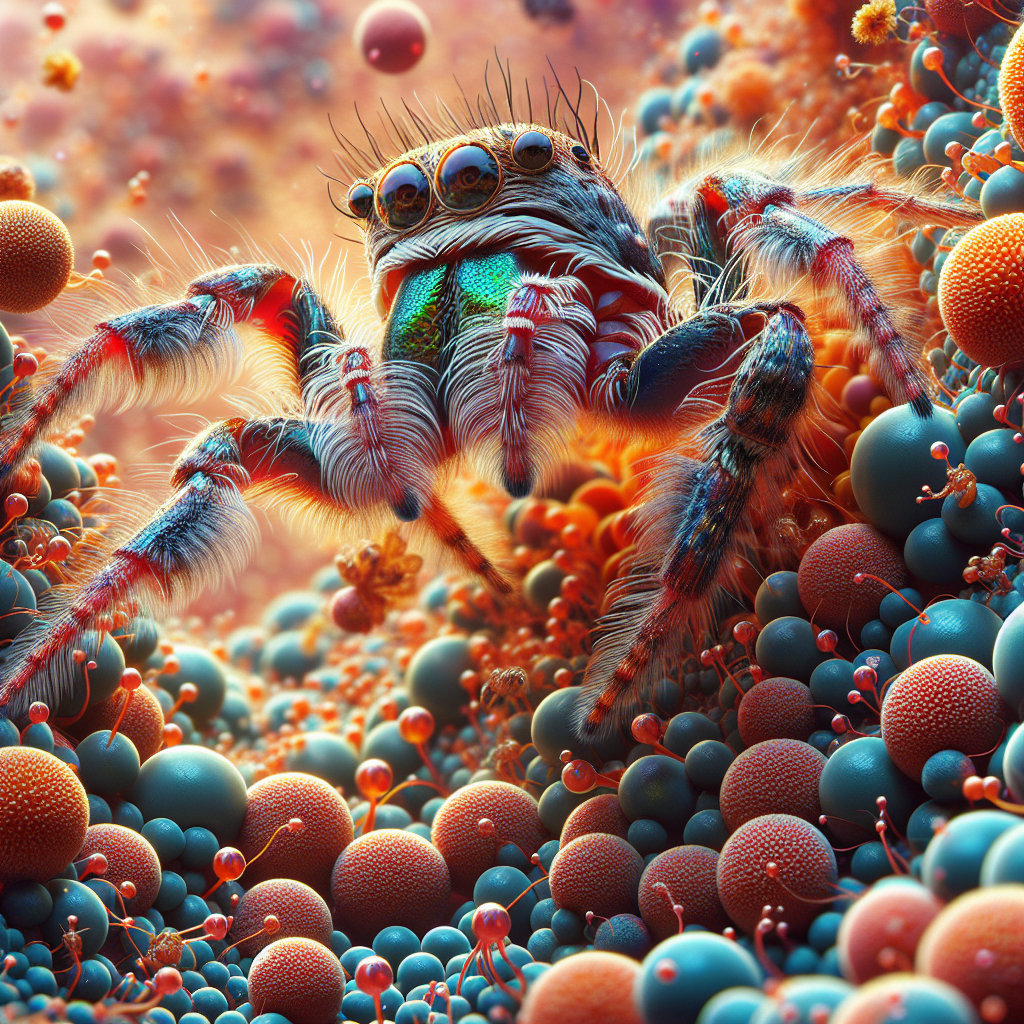

Ever stumbled across a creature that looks like it should belong in a sci-fi movie, only to find out it's a spider? Meet Cosmophasis bitaeniata, a fascinating jumping spider that calls the lush lands of Southeast Asia home. Known for its spectacular colors and peculiar behavior, this spider isn't your ordinary garden dweller. Picture a vibrant, miniature rainbow with eight legs, hopping from leaf to leaf in the tropical regions of Singapore, Malaysia, and the surrounding areas. It's been on this planet for ages, quietly playing a central role in its ecosystem while capturing the imagination of those lucky enough to witness its antics.
Cosmophasis bitaeniata is not just any spider. It stretches the boundaries of our usual spider-phobia by incorporating a personality that even the most arachnophobic might find charming. This species is nestled in the family Salticidae, known for their incredible jumping abilities and keen vision. But what sets them truly apart is their mimicry and ability to allure ants - a nifty evolutionary trick!
Now, let's unpack that. Why would a spider mimic an ant, you ask? It's like nature’s strategic game of chess. By impersonating an ant, specifically weaver ants, Cosmophasis bitaeniata manages to avoid becoming a quick snack for predators who are not interested in tangling with an ant's strict and often vengeful social order.
However, this mastery of disguise also plays into its favor when hunting. By moving among ants, it avoids detection, blends in seamlessly, and pounces on unsuspecting prey. It's evolution at its dazzling best—a vivid example of adapting to survive and thrive.
For young readers, this leads to a broader point—complexity in nature is often not about sheer strength. It’s about agility, adaptability, and sometimes, a little bit of deception. Might there be lessons for us about surviving and thriving in our complex world?
Zooming out a little, one might wonder how scientists are finding out more about these little magicians of the insect world. It involves a blend of adventurous fieldwork, precise laboratory techniques, and a whole lot of patience. Researchers spend hours observing these spiders in their natural habitats to shed light on behaviors that intrigue us—like how they can navigate, communicate, and ultimately influence the biodiversity of their surroundings.
Now let's have a peek into the conversation around conservation because spiders, like other creatures, face challenges from human activity. While gen z is often at the forefront of climate activism, it’s important to consider every piece of the puzzle. Spiders contribute significantly to controlling pest populations, thereby staving off agricultural devastations. Yet, they are so often misunderstood.
For those hesitant about spiders or leaning towards the more conservative stance of simply wishing they’d disappear from household corners, there are valid concerns about safety and inconvenience. However, engaging with these creatures’ roles in larger ecosystems can foster respect for their persistence and resourcefulness.
Insights like these push us to reconsider the balance between fear and appreciation. Encouraging understanding over preconceived notions helps not just with spiders, but in various aspects of society. Inclusive thinking urges us to see connections and recognize value, irrespective of our initial perceptions.
Back to the elegant Cosmophasis bitaeniata. Observing this tiny acrobat, one can’t help but be reminded of the interconnected dance of life: survival, adaptation, mimicry, and flourishing in one's niche. Each leap it makes harks to the greater leaps society is encouraged to take, acknowledging the hidden webs that bind us all.
These spiders, though tiny, teach immense lessons not only in their immediate environment but potentially to the broader canvas of human interaction. They remind us of the subtle power of diversity and adaptation. Like the spider's vibrant markings, we, too, are capable of thriving by embracing diversity and learning from the intelligent ways of nature.