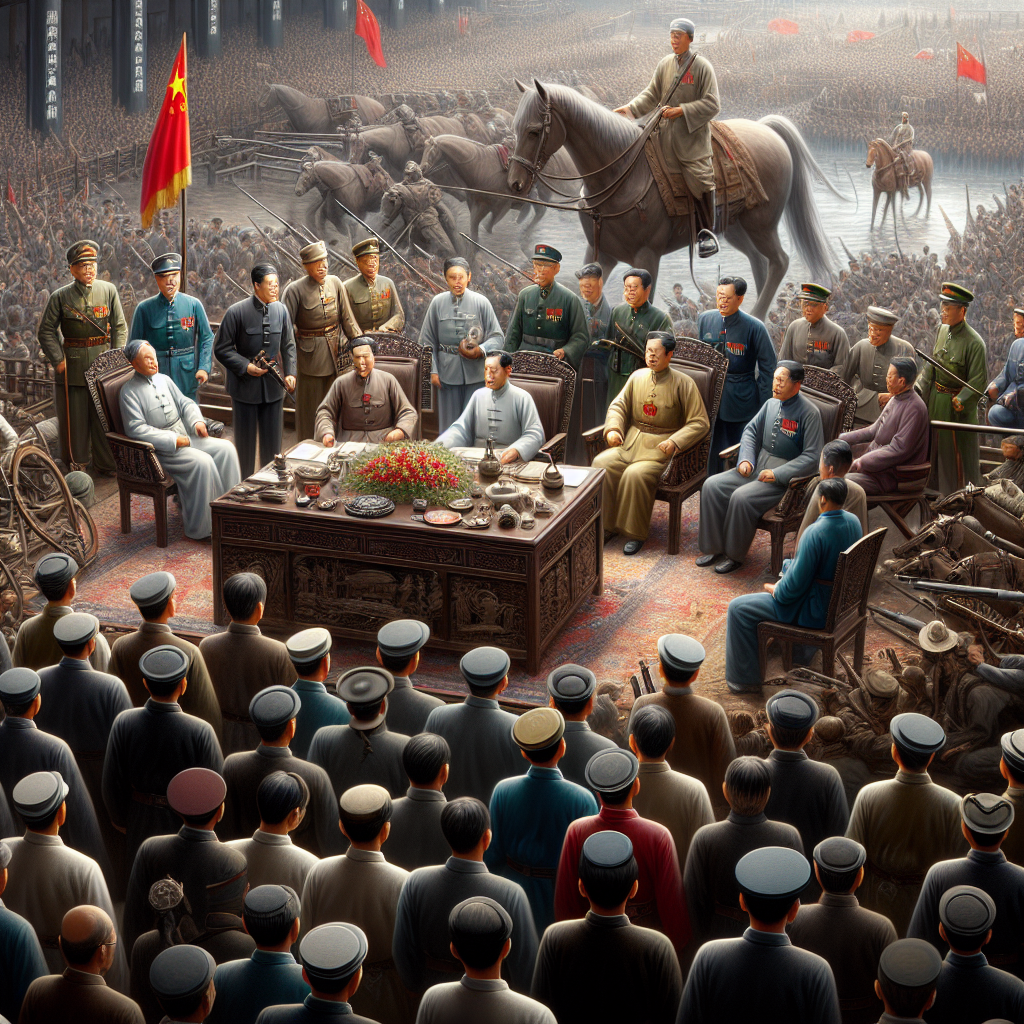

Once upon a fractious time in early 20th century China, amidst turbulence and power shifts, we encounter a striking figure named Chen Jitang, a warlord who wielded significant influence in the Guangdong region from the late 1920s to the mid-1930s. Born in 1890 near Xingning in the Guangdong province, Chen rose from humble beginnings to command an army, rule over vast territories, and influence the national politics of the Republic of China. His story, set against the backdrop of a China in chaos as it grappled with competing warlords, a fragile republican government, and external pressures from imperial powers, is both fascinating and complex.
Chen Jitang's influence was rooted in his deep military background and shrewd political maneuvers. Graduating from the Baoding Military Academy, which bred many influential military leaders, Chen developed a reputation as a capable strategist. In an era defined by warlordism, where might often equaled right, Chen carved out his domain with tenacity, skillfully balancing power dynamics and forming alliances to bolster his dominion over southern China. His leadership by force was complemented by projects that appeared progressive for the time, making Chen a curious fusion of warlord and reformer.
His governance in Guangdong is notable for promoting economic development and societal order. Chen invested in infrastructure development, education reform, and industrial growth within his jurisdiction, fostering an image of a benevolent dictator. However, it's important to remember the complexity of his rule. While he championed modernization, his administration was not immune to corruption and brutality, hallmarks of many warlord regimes. His rule reflects the contradiction present in many authoritarian systems, where public good often intertwines with personal power pursuits.
Yet, Chen's time in power wasn't indefinite. The complex world of Chinese politics in the 1930s was characterized by shifting allegiances. Chen initially aligned with Chiang Kai-shek's Kuomintang government, capitalizing on mutual benefits. But as Chiang sought to consolidate authority, Chen's autonomous power in Guangdong became a target. In 1936, a political struggle with Chiang's central government culminated in a decisive shift. Facing insurmountable pressure, Chen resigned and fled to Hong Kong, marking the end of his dominion in southern China.
Chen's life and legacy provoke debate. While some view him as a protective regional leader who brought stability and temporary economic prosperity to his realm, others criticize his reliance on military might and autocratic rule. This duality - seeing Chen both as a forward-looking leader and a self-serving warlord - aptly captures the reality of many historical figures who operated in tumultuous times. History often demands a nuanced perspective, urging us to acknowledge achievements while not glossing over the darker aspects of their actions.
From a broader perspective, Chen Jitang's story is part of the larger narrative of China's transition through the early 20th century. His reign underscores the difficulties China faced in trying to unify under a single government while dealing with foreign pressure, internal strife, and visions of development. These decades saw China wrestle with its identity amidst modernity and tradition, unity and division, nationalism, and external interference.
Chen's era illuminates the chaos and opportunity that defined the warlord period in China. This period was marked by fragmentation, but also a surprising amount of innovation in regions like Guangdong under leaders like Chen. The warlords, often painted solely as despots, were, in many ways, accidental agents of modernization, albeit through contentious means. They challenged existing norms, albeit sometimes violently, but in ways that inadvertently opened up new possibilities for regional growth.
In understanding figures like Chen Jitang, one has to appreciate the multifaceted nature of leadership during upheaval. It's easy to categorize leaders as entirely righteous or corrupt, but real life rarely offers such simplicity. Leaders acting under pressure often find themselves pushed to make stark decisions, sometimes to benefit the public, other times for personal gain. Viewing Chen's legacy, these tangled motivations provide a richer context to analyze how power is wielded and its impact on governance and societal advancements.
Today, as we reflect on historical narratives like Chen Jitang's, it's vital to distill lessons on leadership, authority, and regional development. Chen's life serves as a reminder of the fine line between progress and authoritarianism, one where intentions and outcomes frequently muddle. Gen Z, along with future generations, will face their own complex leadership challenges, and understanding historical examples provides crucial insights. History often portrays the past in stark contrasts, but in reality, much of it resides in shades of grey, demanding both critique and empathy.